Showing posts with label David Gantz. Show all posts

Saturday, April 14, 2012

Pulp Art Exhibition at Syracuse University NYC Lubin House


Recently I attended a wonderful pulp art exhibition with my daughter Michelle at Syracuse University's Lubin House in Manhattan. The Palitz Gallery is at 11 East 61st Street, just a block away from my office, and the exhibition ran from February 13 through April 12. 

I had been meaning to get over there since I heard about the exhibit, and knowing that Syracuse University is the repository of the Street & Smith archives (I'd used their resources in the past, delving into the S&S editorial records for my Joe Maneely biographical research), my expectations were that it would be a great show. I wasn't disappointed.

My daughter Michelle is an art history major at NYU and I've accompanied her to nearly every museum she's had to visit during the course of her studies.... The Metropolitan Museum of Art, The Museum of Modern Art, The Frick Collection... you name it, we've been there. Now I had the chance to turn the tables! 

On the very last day of the exhibition, while meeting for lunch, I informed her that we were going to an art exhibit of "my" choosing, and we strolled across Park Avenue to Lubin House. What follows is a short review and some photos. The only link to Martin Goodman and his Red Circle pulps was that the primary artist featured in the exhibit was the celebrated Norman Saunders, one of Goodman's finest pulp and magazine cover artist/painters. Additionally, the great science fiction pulp pioneer publisher Hugo Gernsback was also discussed and displayed. Long held hearsay depicts Martin Goodman starting his career in publishing intersecting in some capacity with Gernsback.  Lastly, Frank R. Paul was also exhibited. Paul was Gernsback's primary cover artist as well as painting covers for Goodman's science fiction pulps (explained below) and his debut comic book cover, Marvel Comics #1.


All of this ties in nicely with my upcoming book "The Secret History of Marvel Comics", dealing extensively with Martin Goodman's Red Circle pulp line and the artists who contributed. (Note that the book has been expanded to 300 pages and this is not reflected in the pre-order ad below).


The Secret History of Marvel Comics


With that connection to this blog's mission statement linked, I now present below:


ORANGE PULP: THE PULP MAGAZINE AND CONTEMPORARY CULTURE


Program Booklet (front cover) art by Norman Saunders


Program Booklet (back cover)


The program booklet above gives a excellent concise background into the history of the pulp in American culture, focusing on Street & Smith, the obvious choice as most of the program consists of holdings in their library archives.


The exhibit is broken down into parts in the booklet. I've added photos from the exhibit for context:


Introduction: "Orange Pulp - The Pulp Magazine & Contemporary Culture". The pulp novel is placed into historical context by Sean Quimby, Director of Special Collections at Syracuse University Library.


Street and Smith: A brief history of the company and numerous examples of their pulp and dime novel output, including some some vintage photos of the famous Street and Smith printing presses. Street and Smith also had a comic book line in the 1940's, After the success of their Shadow pulps, Street and Smith debuted their comic book line with The Shadow in 1940 (The debut issue put together by Jack Binder and the Chelser Shop without Shadow creator/author Walter B. Gibson's knowledge. He soon came aboard). Titles including Doc Savage, Bill Barnes, Blackstone, Super Magician and Red Dragon would follow. Timely/Atlas star artist Joe Maneely made his comic book debut in Street and Smith's Red Dragon #3 (May/48). An exhaustive look at Maneely's Street and Smith career will be seen in my future art biography on the artist.


Hugo Gernsback: A brief history of Gernsback and his importance to the history of the science fiction pulp. Below are two cover examples of Gernsback's seminal Amazing Stories pulp, including the debut of Philip Nowlan's Buck Rogers (Aug/28). The artist was Frank R. Paul, the father of science fiction art and Gernsback's #1 artist. Paul's Goodman connection is two-fold. First he painted two covers, Marvel Science Stories Vol 1, #2 (Nov/38) and Dynamic Science Stories Vol 1, #1 (Feb/39) (and a score of interior illustrations in 10 Goodman sci-fi issues). Second, he was the cover artist for the very first Timely comic book, Marvel Comics #1 (Oct/39), featuring the blazing debut of the Human Torch. Once again, the link is that Goodman knew Paul from his earlier Gernsback days and considered him his favorite science fiction cover artist.


Artwork by Frank R. Paul


Marvel Comics #1 (Oct/39) - Frank R. Paul artwork


The Shadow: An overview of Street and Smith's iconic pulp star. (See display in photo below).


Pulp Writers: A discussion of everyone from Tenessee Williams, Joseph Conrad, Dashiell Hammet, Isaac Asimov, Robert E. Howard, and H.P. Lovecraft, to William Burroughs (as William Lee) in the classic Ace Double Novel D-15 "Junkie" (1953)Below is my copy of this killer pulp paperback. The only quibble I'll make is that this is a mass-market paperback, and not a pulp.


Here is a letter from Ray Bradbury to Frederil Pohl:


Isaac Asimov: A brief overview of his pulp writing history. For the record, Asimov made a single appearance for Martin Goodman, contributing the short story "Shah Guido G." in Marvel Science Fiction Vol 3, #5 (Nov/51). Illustrations for this story were by Lee Ames.


Pulp Artists: A discussion about the importance of the painted cover in drawing in a reader browsing the newsstands. Mentioned are N.C. Wyeth, Milton Luros, Margaret Brundage, Hannes Bok and Norman Saunders. Brundage was world renowned for her Weird Tales covers. Bok was equally renowned for his science fiction artwork and contributed the covers to Goodman's Marvel Science Fiction Vol 3, #4 (Aug/51) and Vol 3, #5 (Nov/51), as well as contributing illustrations to Vol 3, #5 also.


Norman Saunders: Norman Saunders gets the bulk of this exhibit. A brief history is depicted and then hanging in the gallery are at least 7 original paintings by the pulp master, all I believe belonging to the Syracuse University Art Collection and from Street and Smith pulps. Saunders' Martin Goodman career will be covered in detail in my upcoming book.


Pulp Readers: A brief discussion about the audience for these publications and their cultural context.


And finally, "The Pulp - A Reminiscence by a Reader & Collector", a two-page pulp labor-of-love by Gary Shaheen, whom I believe loaned material for the show. Gary is a senior vice-president at Syracuse University's Burton Blatt Institute and a passionate pulp collector and historian. Together with Sean Quimby (Director of Special Collections) and even pulp historian David Saunders (Norman's son, who lent his expertise and permission to reproduce his father's work), a wonderful exhibit was produced.


Here are some photos from the exhibit:


The first photo below is Lubin House from across the street on 61's street. The second is a close-up of the exhibit advertisement hanging outside.


As you enter the room upstairs, on the immediate right was a wall display of assorted pulp titles in all genres. (Sorry about the flash glare in the middle).


Important to us here is a single Goodman Red Circle pulp in the third row (and the only one in the entire exhibit) American Sky Devils Vol 1, #4 (Jan/43). This was a 6-issue war-era pulp, a title that ran through the heart of World War Two. Nearly all of the stories supported as propaganda the United States air war against their Japanese war enemies. Authors included David C. Cooke ("The Stop-Watch Pilot") who also wrote for Lloyd Jacquet's Funnies Inc. shop and contributed numerous text stories to early Timely comics put together in that shop. 


Other David C. Cooke Goodman pulp stories can be found in:


Complete Sports Vol 6, #5 (Apr/49) "The Home Run That Wasn't"
Complete Sports Vol 7, #1 (Oct/49) "Grudge Fight"
Western Short Stories Vol 6, #8 (Sept/49) "The Last Deal"


David C. Cooke's Timely comic text stories include:


Marvel Mystery Comics #2 (Dec/39) "Death-Bird Squadron"
Marvel Mystery Comics #3 (Jan/40) "Siegfried Suicide"
Marvel Mystery Comics #4 (Feb/40) "Warning Enough"
Marvel Mystery Comics #7 (May/40) "Blasting Bombers"
Marvel Mystery Comics #15 (Jan/41) "Dreadnaught from Mars"


I also recently came across an advice article he wrote for prospective authors in the Feb/49 issue of the trade magazine Author & Journalist. The piece, entitled "Rejections Are Your Own Fault", is a critique of the majority of the writers sending in submissions to the pulps and magazines of the day. Cooke is basically giving us Sturgeon's Law, that 90% of everything submitted is garbage and it takes a lot of work for an editor to wade through piles of garbage to locate something that can be printed. Cooke's commentary is based on his position as editor at Whisper magazine.  Sorry about the quality of the image below. It's a photocopy of a microfilm image.


Author & Journalist (Feb/49) 


This particular cover was painted by Norman Saunders, who also painted the covers to issues #1 and #2. Allen Anderson painted #3. The interior pulp illustrations were frequently handled by Timely comics staffers and included artists Stan Drake, George Klein and David Gantz, as well as non-Timely illustrators like J.W. James, Harper and H.W. Kiemle. Below is my copy of the pulp.
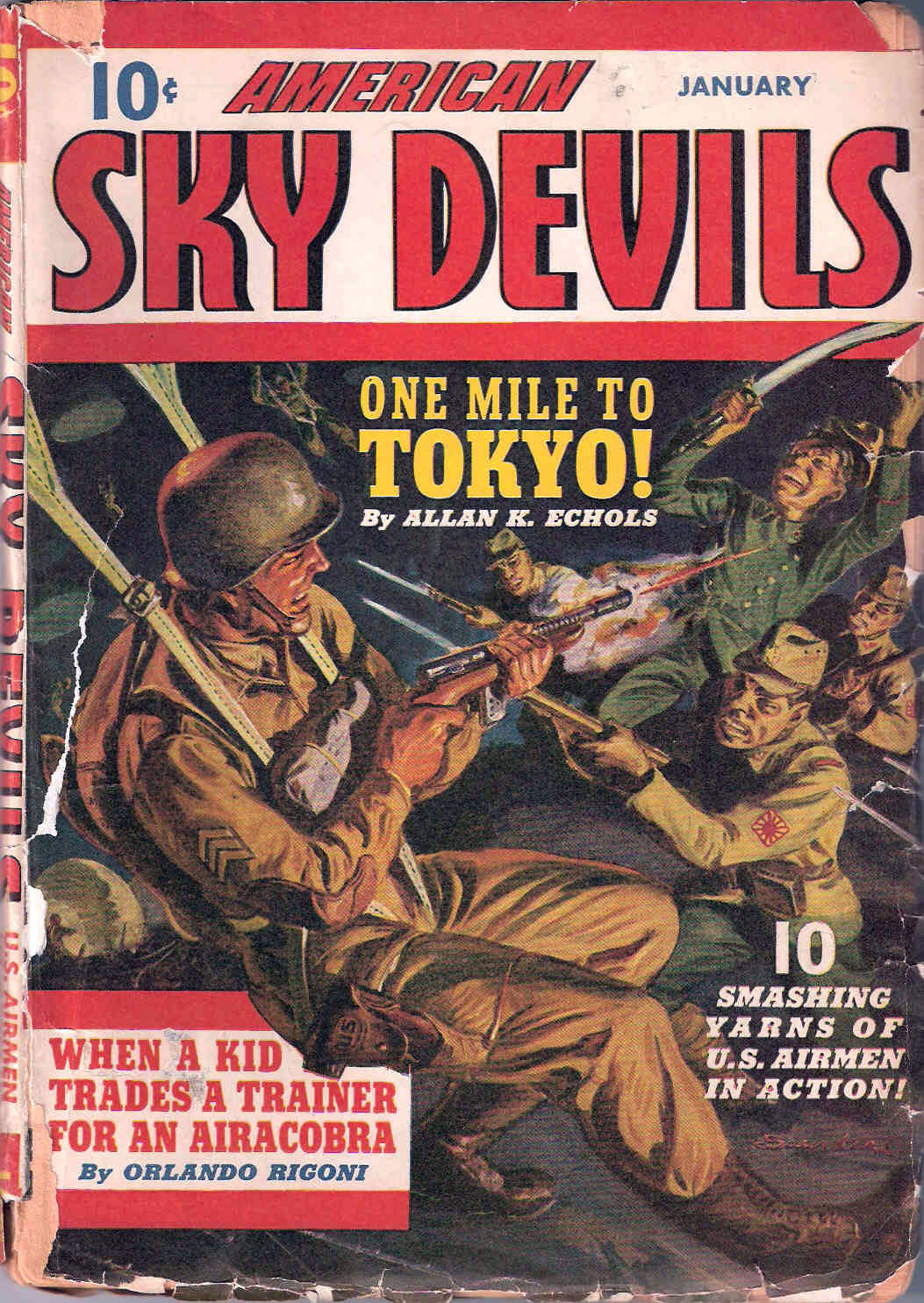

American Sky Devils Vol 1, #3 (Jan/43) - Norman Saunders cover


As we continue left we come across an exhibit on The Shadow, Street and Smith's most iconic pulp hero. The display had a component running audio from the radio show on a loop.


Continuing to the left we see a trifecta of gorgeous Street and Smith original paintings by Norman Saunders.


And more:


Artwork by Milton Luros:


Artwork by Milton Luros in 10 Story Detective (Jan/44)


The illustration at the top right above is an original illustration by August Schomburg, an older brother of noted science fiction and Timely Comic cover artist Alex Schomburg. Alex's Martin Goodman career will be covered in detail in my book.


The image at the lower right bottom above is an original pen and ink illustration by L.F. Bjorklund, the most prolific western interior pulp illustrator that Martin Goodman employed. His riveting images can be found in nearly every western and adventure Red Circle pulp published throughout the decade of the 1930's, including all the illustrations utilized in all three issues of the Red Circle's Ka-Zar. I apologize for not getting a better picture of this illustration. Here's one below.


L.F. Bjorklund -  BEST WESTERN Vol 1, #1 (Sept35) p.4

And lastly:


Doesn't this look like it's more fun than M.O.M.A or the Met, Michelle?


SOURCES:


  • All photographs were taken by myself at the Orange Pulp exhibit at Syracuse University's Palitz Gallery at Lubin Hall on April 12, 2012.
  • Images of Ace's D-15 "Junkie" by William Burroughs, American Sky Devils Vol 1, #3 and L.F. Bjorklund's illustration in Best Western #1 (Sept/35) were taken from my own collection.
  • Special thanks is given to Katie Hudson '10 (Syracuse University), who was able to locate for me the very last copy of the exhibit's program book. All had been given out by the time I saw the show on the last day and Katie went out of her way to find me a copy!


Saturday, January 14, 2012

OT : Peanuts - A Comic Book History


I'm extremely happy to present this blog's first Off Topic post. While they will be far and few between, I always wanted to consolidate past articles I've written into one permanent place, regardless of their content.

With that in mind, I now present an article I wrote back in 1997 for the Comics Buyers Guide 1. For the last 7 years it was hosted on my pal Ken Quattro's Comicartville site, a haven for wonderful comic-related articles that pre-dated the more recent blog era. I'm extremely appreciative to Ken for providing the space to me for all those years. With the recent announcement of "new" Peanuts comics being released by KaBOOM! Studios, I thought this a perfect time to dust this article off once again. I'm leaving the main text of the article intact, only making a handful of updated credits. I will use many more examples of artwork than we were able to use in the past, though.


KaBOOM Peanuts #1 (Jan/12)


So without further ado, I present :


(original logo created by Ken Quattro)


2003 introduction :

"This article below originally appeared in the November 28, 1997 issue (#1254) of the COMICS BUYER'S GUIDE on the occasion of Charles M. Schulz's 75th birthday. It was fandom's first attempt to collate all the information together about the comic book appearances of Schulz's Peanuts characters and I've left it as it was originally published except for the updated material where mentioned."

Dr. Michael J. Vassallo


Comics Buyer's Guide #1254 (November 28, 1997)


When Charles M. Schulz's comic strip Li'l Folks was finally accepted by United Features Syndicate, re-christened Peanuts and debuted in seven newspapers on October 2, 1950, little did he realize that from such humble beginnings would mushroom worldwide popularity and prominence over the next 50 years. Peaking in the 1960's, this wonderfully endearing slice of Americana has become an institution continuing to delight us to this date. Peanuts can honestly claim the title of the worlds most successful comic strip, producing characters that will remain on the American landscape quite possibly forever.

Much has been written about this strip: Precocious children interacting in a world where adults are never seen, the underlying level of pathos of its main hero Charlie Brown, and most phenomenally, the growth from a minor role to eventual stardom by his dog Snoopy. "Peanuts" is the template for all modern child-star comic strips that followed, up to and including today's precocious wonderkid, the almost equally phenomenal strip, the late and terribly missed, Calvin and Hobbes.

With all that said, and all that has been written about its place in comic strip history, I've seen little or no mention about Peanuts appearances in comic books.

A period of intense research has produced the following information. The earliest comic book appearances of Peanuts have a somewhat cloudy chronology and there has long been some question to its origins as I've found many factual data errors and omissions in the annual Overstreet Price Guide. Based on this fact, Overstreet mentioned appearances will be accepted but confirmation will await further discovery as I continue to locate a few remaining books. The information that follows is as up-to-date as possible.

Peanuts has been published in 4 major comic book waves summarized below :


  • 1) United Feature Syndicate
  • (U.F.S.) (1952-1954), which published a line of comics including TIP TOP, TIP TOPPER, UNITED COMICS, FRITZI RITZ, SPARKLER COMICS, SPARKLE COMICS and PEANUTS (a Comics On Parade one-shot). These were United Feature Syndicate newspaper strip reprints of early 1950's newspaper comic strips.

    • 2) St. John (1955-1957), after a 7 month hiatus, followed when U.F.S. ceased publishing and continued with TIP TOP and FRITZI RITZ. These appear to be Fritzi Ritz and Nancy & Sluggo reprints from earlier U.F.S. issues.

    • 3) Western, under its Dell imprint (1957-1962), after another hiatus, began the third wave with NANCY (Sept/57), then continued withTIP TOP (Nov/57), FRITZI RITZ (Dec/57), FOUR COLOR (1958), and finally PEANUTS (1960 ).  This is all new material created exclusively for the comic books.

    • 4) Western under its Gold Key imprint (1962-1964), which continued the numbering from the Dell title NANCY & SLUGGO and a new, re-numbered PEANUTS. Notable of these issues is the fact that they are primarily re-packaged Dell reprints.


    The history:


    "Peanuts" characters quietly made their comic book debut simultaneously in the Mar/Apr, 1952 issues of TIP TOP COMICS #173 and UNITED COMICS #21. These appearances were not mentioned in Overstreet back in 1997 and discovered by myself. Timeline research, through an exhaustive search of all United Features Syndicate contemporaneous titles and issues, has placed TIP TOP COMICS #173 and UNITED COMICS #21 as the earliest "Peanuts" appearances, chronologically pre-dating all other appearances.


    United Comics #21 (Mar-Apr/52) Peanuts debut
    Tip Top Comics #173 (Mar-Apr/52) Peanuts debut


    TIP TOP COMICS was a long running title stretching back to 1936 and lasting 225 issues to 1961. United Feature Syndicate published #1 -188, St John published #189-210, and the last 15 issues 211-225, (1958-61) were published by Dell, featuring new story art "not" by Charles Schulz. I will explain this shortly. This title over its history featured Hal Foster's "Tarzan", "Li'l Abner", "Fritzi Ritz", "Nancy", "The Captain and the Kids", "Peanuts", and historically speaking, the first published art of Jack Davis (#32, Dec/38, a Buffalo Bob's Cartoon Contest winner, age 12) and first comic work by Harvey Kurtzman (#36, Apr/39 ).

    The Peanuts appearance history in TIP TOP COMICS begins haphazardly. I've established #173 as co-debut and confirmed that #174-183 do not feature Peanuts. #184-188 do feature Peanuts and complete United Features Syndicate's run of the title, including adorable covers to #185-188. St. John's entire Tip Top run features Peanuts from #189-210  and Dell's run from 211-225 likewise.

    The St. John material is reprinted from earlier United Features Syndicate Tip Top issues.

    Issue #173 consisted of two 4-panel, half-page daily strip gags, but by #185, along with being cover featured, Peanuts inside received four full pages of daily and/or Sunday strip reprints.


    Tip Top Comics #185 (Mar-Apr/54)


    Tip Top Comics #186 (May-June/54)


    Tip Top Comics #187 (July-Aug54)


    Tip Top Comics #188 (Sept-Oct/54)


    UNITED COMICS (starring Fritzi Ritz) and FRITZI RITZ were two intertwined titles that presented comic strip characters owned by United Feature Syndicate, most notably Ernie Bushmiller's Fritzi Ritz, a leggy "good-girl art" humor character who happened to be the aunt of Nancy of Nancy and Sluggo fame.


    UNITED COMICS was published in its entirety by United Feature Syndicate while FRITZI RITZ had #1-36 published by United Features Syndicate, #37-55 by St. John, and # 56-59 by Dell. The exact publishing chronology of these two titles, with their Peanuts appearances, is the following:


    UNITED COMICS Vol 1, #1 (Aug/40) [one-shot]

    FRITZI RITZ #1-7 (1948-49) Pre-dates Peanuts

    UNITED COMICS #8-26 (1950-53) Peanuts in #21-26

    FRITZI RITZ #27-59 (1953-58) Peanuts in UFS #27-33, St. John #37-50, Dell #57-59

    The Overstreet Guide misses UNITED COMICS Peanuts appearances in issue #21 to this day (15 years after this article first saw print). The St. John issues are reprinted material from earlier United Features Syndicate United Comics and Fritzi Ritz issues. Dell Fritzi Ritz #56 is the only Dell issue missing Peanuts.


    The Dell issues #57,58,& 59, contrary to all the earlier issues, and similar to the Dell TIP TOP issues mentioned above, have new material exclusively created for comic books. Again, story art is not by Charles Schulz. Each of these issues have a single 4-page story.  


    United Comics #1 (Aug/40) one-shot (pre-dates Peanuts)
    Fritzi Ritz #44 (July/56) [St. John] (Peanuts)


    As can be seen above in the St. John Fritzi Ritz #44 (July/56), contemporary racial stereotyping can be found even in post-code comics aimed at the youngest segment of the comic reading audience.

    Historically, collectors looking for Peanuts in comic books faced an arduous task as the feature appeared haphazardly without any real pattern or sequence.


    The next title where Peanuts appeared was TIP TOPPER COMICS, published by United Feature Syndicate and running 28 issues from 1949-54, comprising more United Feature Syndicate newspaper comic strip characters including Li'l Abner, Abbie & Slats,Fritzi Ritz, Curley Kayoe and Peanuts in issues #16-22, 24-28. The Peanuts are newspaper strip reprints and are 4-panel dailys and/or Sundays over two pages.


    Tip Topper #2 (Dec-Jan/50) pre-dates Peanuts
    Tip Topper #1 (Oct-Nov/49) pre-dates Peanuts
    Tip Topper #26 (Dec-Jan/54) Peanuts
    Tip Topper #27 (Feb-Mar/54) Peanuts


    There are a couple of additional Peanuts strip appearances. United Features Syndicate's Sparkle Comics ran 33 issues from 1948 to 1954. The very last issue, #33 (Feb-Mar/54) had Peanuts. Could there be Peanuts is earlier issues not known about? I think yes as I've not looked in all the issues.


    Sparkle Comics #33 (Feb-Mar/54) Peanuts


    Sparkle Comics #33 Peanuts p.2
    Sparkle Comics #33 Peanuts p.1


    United Features Syndicate's Sparkler Comics ran two volumes. The first volume ran only two issues in 1940. Volume two ran 120 issues to cover date Oct-Nov/54. Two issues are known to contain Peanuts, #115 (Jan-Feb/54) and #120, (Oct-Nov/54). There could be others.


    Sparkler Comics #115 (Jan-Feb/54) "Peanuts"
    Sparkler Comics #120 (Oct-Nov/54) "Peanuts"


    Nancy and Sluggo had two separate runs. The first ran #16 (#1) - 23 from 1949 to 1954 by United Features Syndicate. The second continued the numbering from Sparkler Comics above running from #121-145, published by St. John. Issue #142 (Mar/55) contains Peanuts. As with Sparkler Comics and Sparkle Comics above, there could be additional Peanuts here in issues not seen.

    Nancy will continue being published by Dell starting with #146 (Sept/57) to #173, then changes back to Nancy and Sluggo #174 to #187 (Apr/62) and then published by Gold Key #188-192.  All these issues have new Peanuts material created especially for the comic books not by Charles Schulz, with "one" exception I will show below.


    Nancy and Sluggo #142 (Mar/57) "Peanuts"


    And finally, finishing out the early United Features Syndicate and St. John reprints of Peanuts newspaper strips is a real unique one-shot simply titled PEANUTS, although the indicia states Peanuts No.1, Comics on Parade. The date of this book appears to be from 1953-54 and contained strip reprints such as Willie, Ferdinand, and Strange As It Seems, as well as the earliest Peanuts strip reprints I've ever seen in a comic book, from the dawn of the strip perhaps in late 1950, early 1951.The material is copyrighted up to 1953 by United Feature Syndicate. My guess is that it just pre-dated TIP TOP #184 and FRITZI RITZ #32 (both Jan/Feb, 1954) and followed TIP TOPPER #26 Dec/Jan, 1953, the final TIP TOPPER appearance. Any other suggestions are welcome. The cover below is a rarely seen slice of Peanuts wonderment by Charles M. Schulz.


    Peanuts No.1 (1953?-54?) cover by Charles M. Schulz


    The Dell era :


    When Dell took over publishing NANCY COMICS in 1957 from St. John, Peanuts appeared in the entire run from #146-187 (1957-62), with Gold Key publishing the last five issues #188-192 (1962-63). These Dell issues again, with a single exception, were not drawn by Charles Schulz. All consisted of four-page, self- contained gag stories.

    As mentioned above, NANCY COMICS began as SPARKLER COMICS, running120 issues from 1941-55. It featured the first appearance of "Sparkman" as well as more United Feature Syndicate characters such as Burne Hogarth's Tarzan, The Captain and the Kids, Ella Cinders, Danny Dingle, Frankie Doodle, Abbie and Slats, Broncho Bill, Li'l Abner, Fearless Fosdick and Nancy by Ernie Bushmiller. The title became NANCY with issue #121 in 1955, occasionally titled NANCY & SLUGGO throughout the run.


    Nancy #146 (Sept/57) "Peanuts"


    Researching this article made it obvious, as mentioned, that the long multi-paged "Peanuts" stories found in the Dell issues of FOUR COLOR, PEANUTS, NANCY, TIP TOP & FRITZI RITZ (as well as the reprinted Gold Key stories) had been drawn by someone other than "ol Sparky" himself, Peanuts creater Charles M. Schulz. Upon reviewing these stories one could see this, as some stories have backgrounds that don't appear as if drawn by Schulz. Also, occasionally actions and dialogue in these extended stories appear slightly "out of character" if you will, compared to their newspaper counterparts.

    I've always been under the impression that Charles M. Schulz always drew and directly supervised all aspects of his strip and characters, so this was something of a surprise. From a variety of sources, I learned that these DELL issues were produced by a crew of artists working for Schulz and who did advertising artwork for him. The main artist was Dale Hale. This information has been confirmed for me by the late comic strip art collector/historian/agent Mark J. Cohen, who was gracious enough to ask Charles M. Schulz over dinner about his contribution to those Dell issues. Mr. Schulz enumerated that he did the very first one himself with Jim Sasseville doing the next few and Dale Hale doing all the rest. In fact, Sasseville was working with Schulz between 1957 and 1959 on a single-panel sports cartoon feature titled "It's Only a Game" that ran three times a week. It was cancelled after 63 weeks in 1959.


    Schulz's claim to have drawn the first issue was not clear to me. Chronologically, NANCY #146 (Sept/57) is the first Dell appearance of Peanuts. The first FOUR COLOR Peanuts issue,#878, appeared cover dated in 1958. Going back to examine all these issues one at a time has led me to believe that Schulz was right on the money. NANCY #146 really looks like Schulz's work. #147 definitely is not Schulz but #148 may be . Nothing else . FOUR COLOR #878 (1958) likewise is not, nor are any other Dell or Gold Key issues.


    Of major note also is that much of the non-Peanuts material in Nancy was written by John Stanley, who also introduced Oona Goosepimple into the series.


    Peanuts in Nancy #146 (Sept/57) p.1 of 4 ; Art by Charles M. Schulz


    Timely artist David Gantz has related in a recent interview that he wrote one Dell issue for Schulz (see ALTER EGO #13, Mar/02). Gantz's memory is spotty here as he incorrectly mentions Schulz doing all the rest himself. Additionally, continued research by Derrick Bang has revealed that Jim Sasseville was actually the first artist to follow Schulz on the DELL issues, and drew the Peanuts stories in NANCY #149-168, FRITZI RITZ #57-59, TIP TOP #211-215 as well as FOUR COLOR #878 and parts of #969 (see the Feb 8, 2002 issue of CBG for full details). Bang also postulates Tony Pocrnick, a Schulz associate, possibly following Dale Hale on a handful of late Dell issues. Note also that Dale Hale, who did the bulk of the Dell run, was interviewed by Nat Gertler in HOGAN'S ALLEY #8 (Fall/2000) where he relates even more details about his contributions to the Dell Peanuts appearances : http://www.aaugh.com/guide/ldale.htm

    All new data on the early Peanuts appearances have been uncovered and tallied at Nat Gertler's wonderful AAUGH.com website on our Peanuts Stories in Comic Books page : http://www.aaugh.com/guide/pcb.htm


    (With the more recent addition to the list of NANCY #142 and SPARKLE COMICS # 33 and SPARKLER #115 and 120).


    After a seeming Schulz drawn test-run in NANCY #146, Dell releases a series of three Peanuts issues in their Four-Color series. They are #878, #969 and #1015. These will immediately be followed by the continuation of the series now called PEANUTS and numbered #4-13 (1960-62)

    All these covers are beautiful wonderlands of intense and bright colored backgrounds with large signed simple Schulz drawings of Charlie Brown and Snoopy on every cover. I once owned a copy of the debut 4-color issue below that someone had drawn glasses and an angry face over Charlie Brown in ballpoint ink. It scared the hell out of my then 3 year old daughter Michelle who adored the Peanuts characters in their animated cartoons on television! Now 20, she still remembers it!


     Four Color #878 (Peanuts #1) (1958)

    Four Color #969 (Peanuts #2)  (1958)

     Four Color #1015 (Peanuts #3) (Aug-Oct/59)

    Peanuts #4 (Feb-Mar/60)

    Peanuts #5 (May-July/60)

    Peanuts #6 (Aug-Oct/60)

    Peanuts #7 (Nov-Jan/61)


    Peanuts #8 (Feb-Apr/61)

    Peanuts #9 (May-July/61)

    Peanuts #10 (Oct/61)

    Peanuts #11 (Nov-Jan/62)


    Peanuts #12 (Feb-Apr/62)


    Peanuts #13 (May-July/62)


    The stories in these issues vary in length , some up to 8 pages long. A peculiar anomoly should be noted about PEANUTS issues #4-13. The back covers seem to exist in two variants. One is simply a full page advertisement for candy, breakfast cereal or children's toy, but the other is a full page Peanuts gag strip similar to those found on the inside front or inside back covers. Both variants are of the same printing. This was a common occurrence in all Dell issues published from mid 1956 on. Not having both types to compare, I don't know whether the Peanuts back cover actually has an additional page of Peanuts material or not. I'll post what I have and if anyone can compare to theirs and give me feedback, I'd appreciate it greatly.


     Four Color #878 (Peanuts #1) (1958) [back cover]


    Four Color #979 (Peanuts #2)  (1958) [back cover]


    Four Color #1015 (Peanuts #3) (Aug-Oct/59) [back cover]

    Peanuts #4 (Feb-Apr/60) [back cover]

    Peanuts #8 (Feb-Apr/61) [back cover]


    Ok, it's not Peanuts but I love old cereal ads! Anybody remember what Twinkles tasted like?


    Peanuts #9 (May-July/61) [back cover]

    And remember when kids could buy BB rifles through the mail from a comic book ad?


    Peanuts #10 (Oct/61) [back cover]

    Peanuts #13 (May-July/62) [back cover]


    The Dell issues of Tip Top Comics ran 15 issues from #211 (Nov/Jan/58) to #225 (May-July/61) before the axe fell. The entire run consisted of just three main features : Nancy & Sluggo, Peanuts and The Captain and the Kids. Peanuts was usually an 8 page story in the middle of the book. All the covers were vignette covers so Peanuts appeared on all 15 covers as one of three small cover depictions per issue.


    Here is the debut Dell Tip Top issue, #211 (Nov-Jan/58) :


    Tip Top Comics #211 (Nov-Jan/58) ; "Peanuts"


    Followed by the last issue of this long-running comic book series, #225 (May-July/61) :


    Tip Top Comics #225 (May-July/61)

    I'm also going to present "all" the cropped Peanuts cover scenes from all 15 Dell Tip Top issues:


    Tip Top #211
    Tip Top #212


    Tip Top #213

    Tip Top #214

    Tip Top #215

    Tip Top #216

    Tip Top #217
    Tip Top #218
    Tip Top #219
    Tip Top #220
    Tip Top #221

    Tip Top #222

    Tip Top #223

    Tip Top #224

    Tip Top #225

    The final Dell title to examine is the 4 issue run of Fritzi Ritz, #56 (Dec-Feb/58) to #59 (Sept-Nov/58). Peanuts can be found in #57,58,59 and run a total of one 4-page story per issue.

    Fritzi Ritz #56 (Dec-Feb/58) ; no Peanuts

    Fritzi Ritz #57 (Mar-May/58) ; "Peanuts"

    Fritzi Ritz #57 (June-Aug/58) ; "Peanuts"

    Fritzi Ritz #59 (Sept-Nov/58) ; "Peanuts"


    Gold Key :

    The final "Peanuts" comic book appearances are the 4-issue Gold Key run titled PEANUTS (1963-64) which overlaps and outlasts the last 5 issues of NANCY and SLUGGO #188- 192 (1962-63). 


    The Gold Key PEANUTS issues are nothing more than reprints of the first four issues published by Dell, Four Color #'s 878, 969, 1015 and PEANUTS #4, minus the Nancy and Sluggo story. I suspect the Nancy and Sluggo issues are reprints also.
     
    One nice feature of the Gold Key PEANUTS (1-4) and NANCY and SLUGGO (188-192) issues are the fact that the back covers are pin-ups of the front covers minus the title and copy, which gives these books a very neat "wrap-around cover" appearance. John Stanley scripted the Nancy stories and we will see the appearance of Stanley's Oona Goosepimple in the Gold Key issues below. The artwork is Dan Gormley.


    Peanuts #1 (Gold Key) (May/63)

    Peanuts #2 (Gold Key) (Aug/63)

    Peanuts #3 (Gold Key) (Nov/63)

    Peanuts #4 (Gold Key) (Feb/64)

    Nancy and Sluggo #188 (Gold Key) (May/63)

    Nancy and Sluggo #189 (Gold Key) (Oct/62)

     Nancy and Sluggo #190 (Gold Key) (Apr/63) 

    Nancy and Sluggo #191 (Gold Key) (July/63)

    Nancy and Sluggo #192 (Gold Key) (Oct/63) 

    I'm betting there are still some Peanuts appearances to be found in United Features Syndicate and St. John issues of titles like Nancy, Sparkler Comics and Sparkle Comics, but for the most part, 99% of it is now accounted for. If anyone notices any errors or has any additions, please let me know.

    Lastly, while this piece is a tribute and study of Peanuts appearances in comic books, we've actually seen just as much artwork by the workhorse of United Features Syndicate's comic books, the great Ernie Bushmiller, long-running artist on Fritzi Ritz, and the creator of her niece Nancy, who eventually eclipsed the elder in fame and popularity.  

    Back in UNITED COMICS #1 one-shot (Aug/40) there was a page devoted to Bushmiller, which I'll present here at the end. Now we know who Fritzi Ritzi's long-suffering boyfriend Phil Fumble was patterned after! 

    United Comics #1 (one-shot) (Aug/40)


    TOTAL PEANUTS COMIC BOOK APPEARANCES
    (1952-64) 153 issues 

    • UNITED COMICS 21,22,23,24,25,26 1952 (6 issues) 
    • TIP TOP 173,184-225 1952-61 (43 issues) 
    • TIP TOPPER 16-22,24-28 1952-54 (12 issues) 
    • FRITZI RITZ 27-33, 37-50,57-59 1953-58 (24 issues) 
    • PEANUTS 1 1953/54 ? (1 issue) 
    • SPARKLE COMICS 33 1954 (1 issue) 
    • SPARKLER 115,120 1954 (2 issues) 
    • NANCY 142,146-192 1957-63 (48 issues) 
    • FOUR COLOR 878,969,1015 1958-59 (3 issues) 
    • PEANUTS 4-13 1960-62 (10 issues) 
    • PEANUTS 1-4 1963-64 (4 issues) 

    EARLY PEANUTS APPEARANCES CHRONOLOGY (1952-54) :

    (United Feature Syndicate)


    1. TIP TOP #173 (Mar/Apr) 1952, UNITED COMICS #21 (Mar/Apr) 1952 
    2. TIP TOPPER #16 (Apr/May) 1952
    3. UNITED COMICS #22 (May/June) 1952
    4. TIP TOPPER #17 (June/July) 1952
    5. UNITED COMICS #23 (July/Aug) 1952 
    6. TIP TOPPER #18 (Aug/Sept) 1952 
    7. UNITED COMICS #24 (Sept/Oct) 1952
    8. TIP TOPPER #19 (Oct/Nov) 1952
    9. UNITED COMICS #25 (Nov/Dec) 1952 
    10. TIP TOPPER #20 (Dec/Jan) 1952/53 
    11. UNITED COMICS #26 (Jan/Feb) 1953
    12. TIP TOPPER #21 (Feb/Mar) 1953
    13. FRITZI RITZ #27 (Mar/Apr) 1953 
    14. TIP TOPPER #22 (Apr/May) 1953
    15. FRITZI RITZ #28 (May/June) 1953
    16. FRITZI RITZ #29 (July/Aug) 1953
    17. TIP TOPPER #24 (Aug/Sept) 1953 
    18. FRITZI RITZ #30 (Sept/Oct) 1953 
    19. TIP TOPPER #25 (Oct/Nov) 1953
    20. FRITZI RITZ #31 (Nov/Dec) 1953 
    21. PEANUTS (one-shot) #1 ??????? 1953/54
    22. TIP TOPPER #26 (Dec/Jan) 1953/54 
    23. FRITZI RITZ #32 (Jan/Feb) 1954, TIP TOP #184 (Jan/Feb), SPARKLER #115 (Jan/Feb)
    24. TIP TOPPER #27 (Feb/Mar) 1954, SPARKLE #33 (Feb/Mar) 1954
    25. FRITZI RITZ #33 (Mar/Apr) 1954, TIP TOP #185 (Mar/Apr) 1954 
    26. TIP TOPPER #28 (Apr/May) 1954
    27. TIP TOP #186 (May/June) 1954 
    28. TIP TOP #187 (July/Aug) 1954 
    29. TIP TOP #188 (Sept/Oct) 1954
    30. SPARKLER COMICS #120 (Oct/Nov) 1954

    *** Addendum*** 

    In 1995 I upgraded my copy of Four Color #878 (1958) because the image of Charlie Brown's face and eyes were outlined with a ball point pen by a child in the dim past. My then 4 year old daughter Michelle was frightened of this "yucky Charlie Brown" and I found a better copy (seen above in the article) to replace it. I then sold the "yucky Charlie Brown" on eBay for about $7. This year, my now 29 year old daughter saw a photo of herself at 4 with the comic and asked me if she could have it, recalling with a laugh how she was then frightened of it.. I unfortunately told her I had sold it 25 years ago and replaced it with a much nicer copy, something she never knew.

    So an open request to Peanuts lovers everywhere. I'd like to buy back that "yucky Charlie Brown copy of Four Color #878. If anyone ever sees it, if the original buyer ever sees this, please contact me at my e-mail address at the top of the blog post. I would be forever in your debt.

    Below is a cropped, blurry photo of my daughter at age 4 holding the "yucky Charlie Brown" copy of Four Color #878.


    SOURCES :

    FOOTNOTES:

    1. Vassallo, Michael J., Peanuts: A Comic Book History, Comics Buyer's Guide #1254, November 28, 1997, Krause Publications, Inc., Pages 60-62.