Showing posts with label Gasoline Alley. Show all posts

Wednesday, December 7, 2016

"A Date Which Will Live In Infamy" : December 7, 1941

OT : Tales from the New York Daily News Sunday Comics (#3)

Today marks the 75th anniversary of the Japanese bombing of the United States Naval Base at Pearl Harbor, "a date," according to President Franklin D. Roosevelt on December 8th (as he announced the attack to the American people from the radio), "which will live in infamy!" The attack effectively brought the United States into a global, simmering primordial soup of Nazi and fascistic aggression in Europe, coupled with Japanese imperialism throughout the Asian/Pacific region. In the two decades following the end of the Great War, the world had been an ever-growing tinderbox and this event proved to be the match that lit yet another conflagration.

The New York Daily News covered the event this way the next morning, December 8th....


The attack started at 7:53 AM Hawaii time, almost 1:00 PM in New York. 2402 individuals died that Sunday morning, 1175 aboard the USS Arizona alone.  The country was shocked and bruised. Launched by the Japanese battle cry "Tora! Tora! Tora!", the United States would reply with "Remember Pearl Harbor!", becoming as popular an exclaim as the previous century's "Remember the Alamo!" What passed for the mainstream media consisted of newsreels, radio, newspapers and magazines. The propaganda and morale machine kicked into high gear. In the American comic book industry, a year earlier Jack Kirby and Joe Simon had put American patriotism on high alert, depicting Captain America landing a thunderous hay maker into the face of Adolf Hitler on the cover to Captain America Comics #1 (Mar/41).


Soon the Japanese Imperial government joined the Nazis and the Fascists as the enemies of the free world, and the industry became awash in four entire years of superheroes battling the Axis powers, along with stereotyped depictions of same. This mass media depiction rolled over into the animated cartoon industry as Bugs Bunny, Daffy Duck, Donald Duck and even Popeye all pit their merit against the Axis powers.


***( A full history of Timely-Atlas war comics can be found HERE)***


Last week, I purchased a sizable lot of World War II era New York Daily News Sunday comics sections from 1941 to 1945. For years now I've been buying them up, trying to put together a full index of the near-century long comics features from the 1920's to the present. I arrived home from work late yesterday and noticed a large package had arrived. I left it on the couch by my piano and planned to open it today when I got home. I already knew what it was, those "comic sections" I bought. 

Today, I finally found the time to take a look at them, tearing open the over sized mailer. Well I was in for a major shock. The lot of approximately 24 Sunday sections were ordered from earliest (1941) to latest (1945). The 1941 sections started in the month of December and the very first section at the top of this pile that I was staring at was dated December 7, 1941!


Yes, on the 75th anniversary of the bombing of Pearl Harbor, I opened a package from the mail containing the New York Daily News Sunday comics section that was on the newsstands that very Sunday morning. This was complete happenstance and luck. I had no idea what the sections consisted of.

Wow.


In 1987 my wife and I were on our honeymoon in Honolulu and we visited Pearl Harbor a week or so before the 46th anniversary of the attacks. We took the boat to the USS Arizona Memorial and I still recall what a somber feeling it was seeing the actual battleship in the water still leaking oil after all these years, coupled with the knowledge that over 900 bodies of Americans were entombed within the wreck. Here's a composite shot of the memorial's wall of  lives lost, taken on November 27, 1987. (It took 29 years for Photoshop to allow me to merge 3 separate photos into one panorama!)


A few minutes of video from the visit just before the 46th anniversary. The clip spans the Arizona in the water to the wall of deceased American names. At some point a contingent of Japanese tourists throw a wreath of flowers into the water, a wreath that floats poignantly for several seconds.


Our immediate family had only one close member to serve in the war. My great uncle Dominick Vassallo served in the South Pacific in the New Guinea campaign from 4-24-42 to 10-22-45. Unmarried at the time, he was drafted at the age of 35, nearly 36. His brother, my grandfather "namesake" Michael Vassallo, served stateside down south as a sheet metal worker for the war effort. My maternal grandfather Nicola was too old, spending 2 years as a German POW during the first world war for his native Italy.

Here is my great Uncle Dom in the South Pacific during the war. The year could be anytime from 1942-45.


I just finished scanning the entire December 7, 1941 Sunday section. As a treat, without all the long-winded details of the industry, the features, the creators and what not, I present, quite simply and without commentary, the entire 16 pages scanned at 300 dpi and cleaned up a bit. Enjoy them for what they are, artifacts of a nation and culture from exactly three quarters of a century ago. On a morning when all was still innocence and serenity, and folks were mostly concerned with nothing more than the upcoming holiday season, little realizing that life as they knew it and the world was about to change dramatically.

  • Page 1 - Dick Tracy by Chester Gould
  • Page 2 - AD PAGE : My-T-Fine Pudding
  • Page 3 - Little Orphan Annie / Maw Green by Harold Gray
  • Page 4 - The Gumps by Gus Edson
  • Page 5 - Sweeney & Son by Al Posen ; AD: Nestle's Chocolate
  • Page 6 - Smitty / Herby by Walter Berndt
  • Page 7 - Smokey Stover by Bill Holman ; AD: Super Suds soap
  • Page 8 - Winnie Winkle the Breadwinner / Looie by Martin Branner
  • Page 9 - The Ripples by George Clark : AD: Ponds Beauty Box
  • Page 10 - Harold Teen by Carl Ed
  • Page 11 - Tiny Tim by Stanley Link ; AD: Colgate Ribbon Dental Cream
  • Page 12 - Smilin' Jack by Zack Mosley
  • Page 13 - Terry and the Pirates by Milton Caniff
  • Page 14 - Gasoline Alley by Frank King
  • Page 15 - The Teenie Weenies by William Donahey
  • Page 16 - Moon Mullins / Kitty Higgins by Frank Willard


Monday, September 14, 2015

OT : Tales from the New York Daily News Sunday Comics (#2) : "We Are Back!" The 1962-63 Newspaper Strike & the Return of the Sunday Comics

The voice that triumphantly screamed out of the two-ray wrist radio said it all, "WE ARE BACK!" The feature title below the New York Daily News Sunday Comics section banner blared DICK TRACY, and all was right once again with the world. The comics were back because the newspapers were back! The strike was over!


New York City newspaper strikes were and are a predictable factor of the New York City labor situation. In the modern era, after several earlier strikes, there was the two week long 1899 Newsboy's Strike against Joseph Pulitzer, publisher of the New York World, and William Randolph Hearst, publisher of the New York Journal. The strike lasted from July 21 to August 2. This strike struck such a cultural chord that it inspired both Simon & Kirby's Newsboy Legion for National in Star Spangled Comics #7 (April, 1942) as well as the Disney film Newsies in 1992 (and the 2012-2014 Broadway production).

The famous 17 day Newspaper Strike of 1945 from June 30 to July 16 is notable in that 7 daily papers went down as 1700 delivery men walked out. All 7 papers were still actually published and sold out of their plant factories, causing massive lines all around the city as readers waited for as long as two hours in snaking, block-long lines, to get their favorite papers. Wonderful to us is the history that New York City mayor Fiorello LaGuardia read the newspaper comics over the radio, going so far as to do all the sound effects necessary in Chester Gould's Dick Tracy strip on Sundays.

Of course I already covered the 88 day 1978 New York City Newspaper Strike of August 10 to November 5, HERE.

The strike that precipitated the exclamation at the start of this article was the devastating  114 day Strike of 1962-63, from December 8, 1962 to March 31, 1963. I say devastating because the aftermath of the intense labor dispute between the publishers and typographers had the unprecedented consequence of ultimately dooming four of the eight New York daily newspapers. When the work-stoppage ended on March 31, 1963, the strike losses compounded the already existing financial hardships and took down the New York Daily Mirror on October 16, 1963. The New York Daily News bought the Mirror's name and good will, with several of the Mirror's successful comics strips jumping over to the News, including Al Capp's Li'l Abner, Harry Hanan's Louie, and Kerry Drake.


In addition to the Mirror in 1963, the lasting effects of the strike took down in April, 1966, the New York World Telegram, New York Sun, New York Journal-American and the New York Herald Tribune, several of which attempted mergers to stave off the end, but ultimately unsuccessful. The proposed mergers set off another strike that doomed all 4 papers.

This left only The New York Times, The New York Post and The New York Daily News. The Times carried no comics, the Post didn't have a Sunday edition and the sole remaining color Sunday comics section in New York City, by mid 1966, belonged to the New York Daily News.

Now let's get back to the end of the 1962-63 strike. By my calculations, the stoppage bookends 12/8/62 to 3/31/63, and took out 17 color Sunday sections that did not get published. (As I related in my last post HERE, Sunday comics sections were prepared and shipped to newsstands in advance and I was able to procure the Sunday August 13th section that post-dated the 1978 strike by 3 days. So it's not impossible that the first Sunday section of the strike exists)

Looking at the date involved, the strike ended on Sunday, March 31, 1963. Below I will present in its entirety, the very first Sunday section following that strike. But there are problems.
  1. The Sunday Comics section is not dated anywhere.
  2. The section is short by at least a third, only the top features were published
  3. Nearly all of the features concern themselves with the newspaper strike!
So the big question .... Is this actually the Sunday section for the first Sunday back after the newspaper strike? If it is, it should be dated Sunday, April 7, 1963. It's not. It has no date at all. So what exactly is this? Is this a special supplement that ran on the last day of the strike, which was Sunday, March 31, 1963, in preparation to the start of publication on Monday, April 1? Is this sort of an April Fool's section? My answer is, I have no idea.

One thing to consider is that most of these cartoonists prepared full Sunday strips featuring the news that the strike was either over, or just mentioned newspapers in some capacity. These had to be prepared well in advance of the strike's end and probably on the recommendation of the syndicates that sold these strips to the News. 

And a last thought on the matter. If these strips were not part of the regular features' continuity, then they are extras that no one has ever seen since the appearance of this strike-end Sunday section. And if so, that's kind of cool!

Without further ado, here is the section in its entirety. My annotations will accompany each feature.


Cover: Dick Tracy by Chester Gould.(Chicago Tribune New York News Syndicate)
Dick Tracy had the cover position on the Sunday News Comics from the mid 1930's right up to December 7, 1980, the day before former Beatle John Lennon was murdered. It replaced The Gumps on the front page and was ultimately ousted by Hagar The Horrible. This cover was not a Sunday page, just a specialty drawing of Tracy and his gang announcing the end of the strike and resumption of the comics in the Sunday News. If this was a real Sunday section, then Tracy's Sunday page was skipped this week, something I find doubtful.


Page 2: Winnie Winkle by Martin Branner (Chicago Tribune Syndicate)
Branner's signature is in under the title but I don't think he was still doing this strip in 1963, having suffered stroke the year before. This may be his long-time assistant Max Van Bibber. The long-running career-girl feature ran 76 years in total from 1920 to 1996. My oldest News Sunday section in 1929 has Winnie. I'm still in the midst of indexing my collection from 1961 to present and am presently only in 1988. Winnie was still running in the News as of that date, drawn by Frank Bolle. It's a good bet it ran there until the end.

At the bottom of the page is another Martin Branner feature, the humor strip Looie. Looie was soon gone and shortly the News received another, differently spelled Louie from The Mirror, the classic pantomime strip by Harry Hannan. Looie was possibly a revival of sorts of one of Branner's earliest features for the Bell Syndicate in 1919, Looie The Lawyer.

Neither of the above Branner features mention the Strike or newspapers in any way.


Page 3: Terry And The Pirates by George Wunder (Chicago Tribune Syndicate)
The first incarnation of this classic strip was launched in 1934 by the great Milton Caniff. The feature was one of the most celebrated of its time and Caniff's style the inspiration of scores of adventure strip and comic book artists for decades to come. Caniff would leave the feature at the end of 1946 due to creative and control differences with the syndicate and launch Steve Canyon in January of 1947. George Wunder replaced Canniff on Terry, continuing on until February 25, 1973. The Sunday News carried the feature until the month before its demise, January 1973.

This installment does mention newspapers, including  the 8th panel with an image of the New York Daily News, and a mention of "it's like being without the papers" in panel 6, a deliberate strike reference.


Page 4: Brenda Starr Reporter by Dale Messick (Chicago Tribune Syndicate)
Launched in 1940, this very popular feature ran until January of 2011, with Messick retiring from the art chores in 1980, and full relinquishing in 1982. Ramona Fradon was the second artist on the feature until being replaced by June Brigman in 1995.

This one is easy! A full page montage of the newspaper strike being over!


Page 5: Beany by Frank Johnson (Chicago Tribune Syndicate)
Frank Johnson was an assistant to Mort Walker who ghosted on Beetle Bailey, Hi and Lois, and a long run Boner's Ark, both credited and uncredited. According to online sources, Beany incorrectly is credited to have run from 1968 to 1974. As this is 1963, we know the 1968 reference is incorrect. Beany ran sporadically in the Sunday news, usually running vertically against a 3/4 page ad (as seen here), only when ad pages ran (which was not every week). It would alternate with Tweety-Pie by Roy Fox (not the bird!). Beany ran as late as 1979, last seen in the Sunday News Comics on August 19, 1979. Given the incorrect start date in the references, the end date of 1974 is likely incorrect also. Either that or the News ran reprints.

This Beany installment does not mention the strike nor anything about newspapers.


Page 6: 
Smitty by Walter Berndt (Chicago Tribune Syndicate)
Pottsy by Jay Irving (Irving Joel Rafsky) (Chicago Tribune-News Syndicate)

Walter Berndt's
Smitty ran 51 years between 1922 and 1973, ending its New York Daily News Sunday run on March 7, 1971.

Jay Irving's Pottsy ran from 1955 to 1970, ending upon Irving's sudden death. Pottsy continued to appear in the Sunday News for about 2 months before Irving's inventory ran out.

Both Smitty and Pottsy installments below dealt with the end of the newspaper strike.


Page 7: Moon Mullins by Ferd Johnson (Chicago Tribune Syndicate)
The long-running popular strip Moon Mullins ran from 1923 to 1991, ending its Daily News Sunday run on August 28, 1977. My earliest Sunday has the feature in 1929 so there is a straight, nearly 50 year run in the New York Daily News. The feature was created by Frank Willard and Ferd Johnson was an assistant almost from the beginning, eventually taking over the feature in 1958 upon the death of Willard. Johnson had been producing most of the strip for years uncredited.

The strip below as well as the "topper" Kitty Higgins by Johnson, do not deal with the strike or newspapers.


Page 8:
Smilin' Jack by Jack Mosley (Chicago Tribune Syndicate)
Smokey Stover by Bill Hollman (Chicago Tribune Syndicate)

The longest running aviation comic strip, Jack Mosley's Smilin' Jack zoomed the newspaper skyways from 1933 to 1973, although it was not carried by the New York Daily News Sunday section past 1966. This installment's one large panel completely references that the newspaper strike is now over.

Smokey Stover by Bill Hollman ran from 1935 to his retirement in 1973, last seen the New York Daily News Sunday section in September, 1972 (as did his topper Spooky). This entry did not reference the newspaper strike in any way. I have a brief connection to Hollman in that his wife was one of my first patients back in the day.


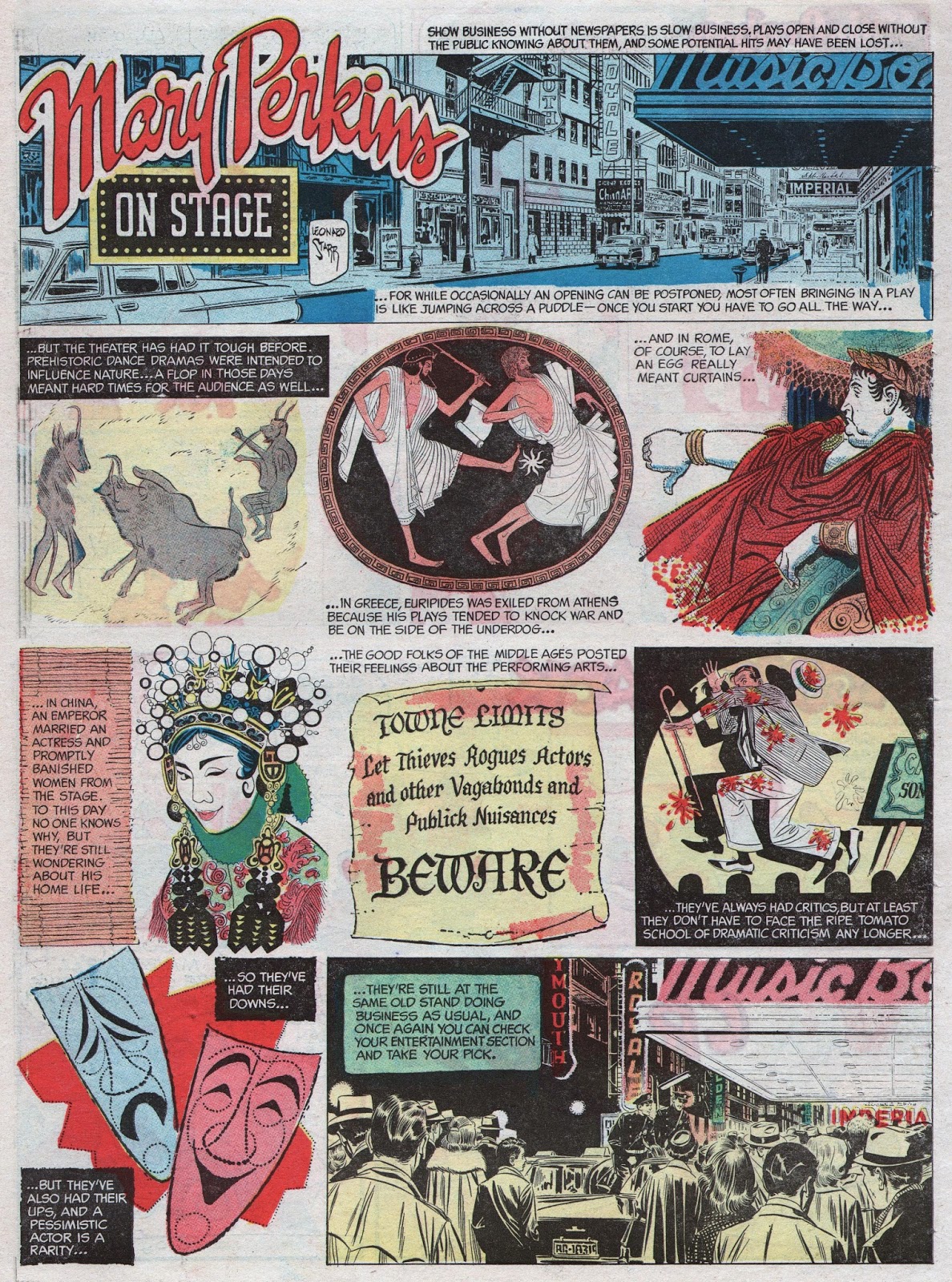
Page 9: Mary Perkins On Stage by Leonard Starr (Chicago Tribune-New York News Syndicate)
One of the most beautiful strips of all, Leonard Starr's showpiece ran from 1957 to 1979, ending in the Daily News Sunday Section of August 29, 1976. Starr then launched a revamped Annie feature on December 9, 1979, based on the success of the Broadway musical.

The strip below does reference the newspaper strike.


Page 10: 
Little Orphan Annie by Harold Gray (Chicago Tribune Syndicate)
Before there was Annie, there was Little Orphan Annie! One of the most successful and popular strips of all time Harold Gray's masterpiece ran from 1924 until his death in 1968. It limped on with other artists and reprints before being supplanted by the relaunched Annie, which ended in 2010.

The strip below makes a reference to Annie's paper route, which may or not be a strike influenced comment.

Aggie Mack by Roy Fox (Chicago Tribune Syndicate)
Launched in 1946 by Hal Rassmusson, Roy Fox took over the feature in 1962 upon Rasmusson's death. It appeared sporadically as an emergency filler until it's last New York Daily News Sunday appearance on June 18, 1972, with a title shortened to just Aggie. (It's previous appearance was on December 26, 1971!) Fox had another infrequently appearing strip called Tweety-Pie that similarly ran as a filler, last appearing In the daily News Sunday section dated February 25, 1979.

The Aggie Mack below does reference the newspaper strike.


Page 11: Dondi by Gus Edson and Irwin Hasen (Chicago Tribune Syndicate)
One of my all-time favorite continued adventure strips! The late Irwin Hasen was a friend of mine and we discussed the feature innumerable times. Unfortunately, one thing I never asked him was about "this" entry, whether it was a one-off or part of the Dondi continuity.

Dondi ran from 1955 to 1986, starting inside, and then was a mainstay of the Daily News Sunday Comics back page from about 1965 to May 1, 1977, when it was supplanted by Charles Schulz's Peanuts. When Edson died in 1966, Bob Oksner assisted Hasen until the strip's end. Ben Oda was the predominant letter of the feature.

In this installment, Dondi and his pal Baldy are looking in the newspaper for a movie review. No strike is mentioned but a "newspaper" is. Dondi Sunday strips always were part of a continuing saga. This episode appears to be self-contained and created solely for the comics' "return".


Back Page: Gasoline Alley by Bill Perry (Chicago Tribune Syndicate)
Finally, the back page and the venerable Gasoline Alley. Walt and his crew would be kicked off the back page in a year or so and replaced by Dondi.

Gasoline Alley is one of the granddaddies of newspaper strips, created by Frank King as a single panel feature debuting on November 24, 1918 and still running today. The original premise of the strip was lifelong bachelor Walt Wallet and his gang of friends (Avery and Doc) hanging around their garage. Most of the gags were of the automotive variety. But on February 14, 1921, Walt found an abandoned baby on his doorstep in the middle of the night, named him Skeezix, and the strip took off into the stratosphere. King had his characters age in real time, with his resulting genius depiction slice of Americana during the early and mid part of the 20th century, never surpassed by anyone.

Frank King handled the feature from 1918 to 1959. His assistant Bill Perry did the Sunday strips only from 1951 to 1975. Dick Moores did the daily continuity from 1959 to 1986 and Jim Scancarelli has produced the feature from 1986 to present.

The strongest recommendation I can make to readers is to look for the 5 volume reprinting of the earliest years of the strip by Drawn and Quarterly entitled Walt and Skeezix. A 6th precursor volume is called Walt before Skeezix, and reprints all the non-continuity automobile gag-a-day strips from 1918 to 1920. The most recent volume from 2011 carries the series up to 1930. (with a new one due in November).Walt and Skeezix, edited by Chris Ware, with annotations and introductions by historian Jeet Heer, and family archive articles and artifacts from the King family, is the finest collection of perhaps the grandest newspaper strip ever presented. Two over-sized volumes of King's fantastic Sunday pages have also been published by Dark Horse, covering the years 1920-1925. Everything can be bought here:  Walt and Skeezix

The strip below does not reference the strike nor any newspaper.


So what to make of all this? Some of the features above appear to be regular installments. Some vaguely mention a newspaper in the strip. Others are absolute "strike's over" installments. Dick Tracy doesn't even publish a Sunday page! Is this "the" first Sunday section after the strike ended, making it April 7, 1963? if so, why is there no date? And no Dick Tracy? Or is it a Sunday "special" presented on March 31, 1963, the day the strike ended. I'm betting on the latter, as a special late edition wrap on the Sunday night the strike ended, with "strike strips" prepared well in advance. If so, it's cool to see "special" strike Sunday pages not seen anywhere else.  It would really have helped if there was a date "anywhere" on this thing!

One thing I have found, is a similar Chester Gould Dick Tracy specialty drawing announcing the end of a New York City newspaper strike, this one in 1966. (From "Dick Tracy, America's Favorite Detective", Citadel Press). So he did it once in 1963 and apparently did it again in 1966.


I welcome all comments and suggestions.