
A happy centennial birthday to the late Jack Kirby, the greatest and most influential comic book creator in the history of the medium (and possibly "all" visual mediums), born Jacob Kurtzberg on Essex Street on the lower east side of New York City 100 years ago today, on August 28th, 1917.
Folks, let's be blunt here. There probably wouldn't even be a comic book industry, as we know it, if it weren't for Jack Kirby. In the medium of sequential adventure storytelling, he single-handedly set down not only the bedrock below, but also erected the towering skyscrapers above, creating the actual visual language that would influence, be copied, and modeled upon by generations of artists and creators. Sure he had collaborators, incredibly talented ones, but those collaborators, while important to specific aspects of his career, merely tweaked and guided raw, unstoppable creative energy as Jack rocketed through the decades and genres, leaving in his wake a modern mythology within a multi billion dollar industry.
The story arc of Jack Kirby's life is well known and will not be told in detail here. The list and details are too long and the accomplishments too deep. There are libraries of bookshelves of Kirby's work in print today, a score of biographical texts and even an entire magazine devoted to him. A tiny highlight sample of his oeuvre would include.......
Captain America (with Joe Simon) for Timely; kid gangs, Boy Commandos, Sandman, et al (with Joe Simon) for DC; the entire romance genre (with Joe Simon); Boy's Ranch, The Fighting American (with Joe Simon); Silver-Age Marvel and the Marvel Universe (with Stan Lee); the Fourth World for DC.... No one created more characters, built more universes and told more stories than Jack Kirby. All of that has been , and will be covered by others. This is a blog about Martin Goodman and Timely Comics so we go back to the very beginning............
Born on the lower east side of New York City, Jack's rough and tumble childhood belayed an inner thirst for knowledge and wonder as he devoured pulp fantasy magazines, newspaper comic strips, Warner Brothers gangster films and classic fiction novels, eventually leading to a career in art. The sequence is telling... a very short stint in art school, cartoons for the Boys Brotherhood Republic newspaper and then at low rung syndicates, apprenticeship at the Max Fleischer studio as an in-betweener on series stars like Betty Boop and Popeye, all leading towards entering the comic book industry with work for Eisner-Iger, and done under a variety of pseudonyms such as Jack Curtis, Curt Davis, Ted Grey, Charles Nicholas (one of 3 men with that name!) and Lance Kirby. Eventually he would settle on Jack Kirby.
In 1940 Kirby began to work for Victor Fox's Fox Feature Syndicate on The Blue Beetle comic strip and met Fox editor Joe Simon. Simon had already completed a stint at Lloyd Jacquett's Funnies Inc. comic shop, producing features for Target Comics, Silver Streak and "The Fiery Mask" and "Trojak" in Daring Mystery Comics for Martin Goodman's nascent Timely Comics.
1940 was also the year Jack would meet and become smitten with the woman who would become his wife and greatest collaborator, Rosalind Goldstein.
While Simon was at Fox, he was also secretly moonlighting for Novelty Press, turning out Blue Bolt, first alone, then hijacking Jack Kirby away from Fox in the evenings. When Fox found out, he threatened Novelty's parent company Curtis Publishing but it went nowhere and the end result was Simon and Kirby were looking to leave.
As all of this was going on, Simon was contacted by Martin Goodman (who liked the earlier work he had done for Timely through the Jacquet shop) with an offer to come work for him. Joe accepted, left Victor Fox and brought along Jack Kirby. Together they were the very first "staff" Timely ever employed, Joe as Editor and Jack as Art Director.
So let's see exactly what Jack Kirby did during his Timely tenure. Some of it may surprise you!
JACK KIRBY : The Timely Years
August, 1940:
In the early part of 1940. Timely Comics was in the McGraw Hill Building at 330 West 42nd Street. Their first project was:
Red Raven Comics #1 (Aug/40).

This was the 4th title in Martin Goodman's new line of comic books, following on the heels of Marvel Comics / Marvel Mystery Comics (Oct/39), Daring Mystery Comics (Jan/40) and Mystic Comics (Mar/40). Timely's flagship title Marvel Mystery Comics was his biggest seller, producing two breakout characters, Bill Everett's Sub-Mariner and Carl Burgos' Human Torch. The contents of this book, with minor exceptions, was produced by the Funnies Inc. crew. As Goodman hired Simon and Kirby, he had his eye on slowly weening away the work coming from comic shops (he had also used material from the Harry Chesler shop in early issues of Mystic Comics) and attempt to bring most of the work in-house. (Contrary to popular belief and Joe Simon's recollections, Goodman wouldn't cut his ties with Funnies Inc. until the end of the war, when Martin Goodman finally bought out the Funnies Inc. contracts.)
Red Raven Comics #1 (Aug/40) was a hodge-podge of weak characters, two of which Jack Kirby drew. The contents was:
Red Raven by Louis Cazenwuve
The Human Top by Dick Briefer
Mercury in the 20th Century by Jack Kirby (written by Martin Burstein)
Comet Pierce by Jack Kirby
Officer O'Krime (a filler) by Al Weine
Magar the Mystic
The Eternal Brain
Although highlighted by two Jack Kirby stories and a Simon & Kirby cover, the book sold so poorly that Goodman cancelled it after one single issue, preferring to change the title to a solo book featuring his favorite character, the fiery Human Torch (star of Marvel Mystery Comics).


Comet Pierce was probably written by Kirby also.


September, 1940:
Daring Mystery Comics #6 (Sept/40) leads off with a Simon & Kirby cover and 2 Simon & Kirby features, Marvel Boy and The Fiery Mask.

Marvel Boy is a strange little strip. The early pages don't look like Kirby and likely is Joe Simon, then Kirby appears on page 4. Marvel Boy is the reincarnated soul of Hercules. In fact, it almost looks like this was originally a proposed Hercules story by someone else (Simon?) converted into a Marvel Boy story by Jack Kirby. The lettering is by Howard Ferguson and the story was probably written by Martin Burstein, as the child in the story is named Martin Burns. At the end is a blurb saying Marvel Boy would return next issue but in actuality the character went on a two and a half year hiatus, not returning until USA Comics #7 (Mar/43), in a strange, inferior, single-story re-boot by what looks like Bob Oksner.


The Fiery Mask originally was created by Joe Simon for Daring Mystery Comics #1 (Jan/40) while working for Lloyd Jacquet (upon reguest by Martin Goodman, who hoped to have a successful flaming companion to his already phenomenally successful Human Torch). Well, it wasn't successful. A second installment appeared in issue #5 (June/40) by Funnies Inc. artist Harry Sahle. This is the third installment, with Jack Kirby now penciling. (A 4th and final installment will appear as a back-up in Human Torch #2 (#1) (Fall/40) with art that looks like it could be by Simon, and may be an inventory story.


Note also that the inside front cover of this issue has an ad for the previous month's Red Raven Comics #1, including the by-line on Comet Pierce by Jack Kirby.

October, 1940:
Marvel Mystery Comics #12 (Oct/40) features an alleged Simon & Kirby cover. There's no other Kirby at Timely this month and there's seemingly barely any here either. I see Kirby-esque elements and a lot of Joe Simon. That's about the best way I can describe it. A great, mostly Joe Simon cover.

*** [Note: October/40 is the first cover month to feature the Simon & Kirby by-line, in Blue Bolt #5.]
November, 1940:
Marvel Mystery Comics #13 (Nov/40):
Simon & Kirby now launch a new feature in Marvel Mystery Comics, "The Vision". The Spectre-like crimefighter from another dimension will prove popular enough to run in Marvel Mystery Comics up through #48 (Oct/43). Goodman, already known to be one looking for knock-off copies of successful properties, may have seen the recent debut of "The Spectre" in New Fun Comics #52 (Feb/40) and asked for a version. Roy Thomas would relaunch Kirby's visual of The Vision as an android in the Avengers #57 (Oct/68) with a beautiful John Buscema cover homage to Kirby's original splash in issue #13.


But comic book work was not the only avenue of income available to Joe Simon and Jack Kirby at Timely. While the comic book sales were rising, recall that Martin Goodman's "primary" area of publishing since 1933 had been in the pulp arena. His notorious Red Circle pulp line had burned a streak across the industry as one of the leaders in volume of issues released (not necessarily in quality). Peaking in 1938 with 27 titles and 87 total pulp issues released, 1939 saw 25 titles and 74 issues released, before dropping precipitously in 1940 to 14 titles and 38 total issues seeing print. The vast majority of these pulps were dominated by Westerns, but crime, adventure, romance, sports and "shudder pulps" waxed and waned over the years. In 1938 Goodman even launched Marvel Science Stories Vol 1, #1, his first usage of the name "Marvel", although sales soon slumped and the content drifted over to fantasy and shudder material, along with name changes to Marvel Tales and Marvel Stories.
Goodman also simultaneously with his delve into comic books, likewise veered into the newsstand market of true crime magazines. Dec/39 saw the change of his shudder pulp Complete Detective to a "flat" magazine Complete Detective Cases. Soon after came the deluge.... Amazing Detective Cases, National Detective Cases, Expose` Detective Cases, Exclusive Detective Cases, and more as the decade went on. The main editor on this line was Robert E. Levee, but starting cover date Nov/40, and for a period of 13 months, the Art Director on these publications was Joe Simon. This allowed him to insert a ton of solo Jack Kirby and Simon & Kirby illustrations wherever they were needed.
Cover date Nov/40 debuted the appearance of Jack and Joe in Goodman's pulp and true crime magazines. Over a span of approximately 9 months, Kirby and Simon & Kirby (and a few solo Simon) rendered over 50 illustrations, many of them double-page spreads. Now a plug... every single one of them can be see in my book with Blake Bell, "The Secret History of Marvel Comics" (Fantagraphics Publishing, 2013), where we devote 40 pages to Jack Kirby's pulp and magazine illustrations for Martin Goodman in 1940 and 1941.
Marvel Stories Vol 2, #2 (Nov/40): (cover by J.W. Scott)
This title began its run as Marvel Science Stories and featured real hard science fiction. When that didn't sell the contents changed to science-fantasy and a name change to Marvel Tales before a final name change to Marvel Stories, and an end to a 9 issue pulp run. It will be revived in 1950 for 6 more issues as Marvel Science Stories once again, then Marvel Science Fiction.

On April 3, 2004, at a con in New York (at Vanguard Publisher J. David Spurlock's table), I was able to show Joe this pulp and talk to him a bit about them. Here is a video clip of Joe signing it for me......


Detective Short Stories Vol 2, #6 (Nov/40) (cover art by J.W. Scott)

Nine gorgeous, hard-hitting detective noir images. Jack at age 23 was already brasher than a substantial amount of the working veteran pulp artists. The scenes are literally bursting with energy and movement.


Complete Detective Cases Vol 2 #6 (Nov/40) (done with Joe Simon)


December, 1940:
Another installment of "The Vision" in Marvel Mystery Comics #14 (Dec/40). (Seemingly several hands here.)


Amazing Detective Cases Vol 1, #2 (Dec/40)


January, 1941:
Simon and Kirby were just about everywhere but at Timely (Kirby was penciling the full-length Captain Marvel Adventures concurrently). Only another installment of "The Vision" in Marvel Mystery Comics #15. Kirby appears to have penciled, inked and lettered this story.
Marvel Mystery Comics #15 (Jan/41):


Complete Detective Cases Vol 3, #1 (Jan/41)


The next one may be partially Joe Simon or even solo Simon. It's hard to tell for certain but I'll include it.

February, 1941:
Marvel Mystery Comics #16 (Feb/41) - "The Vision", again, seemingly penciled, inked and lettered by Jack Kirby


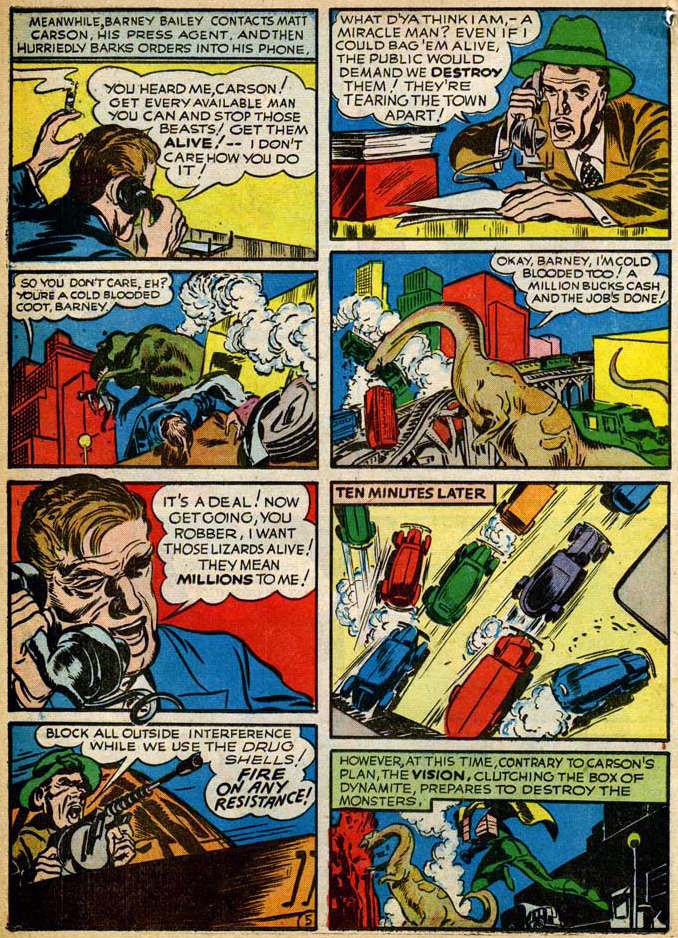


Amazing Detective Cases Vol 1, #3 (Feb/41)


March, 1941:
Leading up to this cover month, at some point Joe Simon interested Martin Goodman with the idea of a patriotic hero, showing him a sketch he had earlier done to work up the character. Publisher M.L.J. was already having great success with The Shield and the main money backing M.L.J. was Goodman's old mentor and now rival, Louis Silberkleit, owner and publisher of Columbia Publications.
(According to Joe Simon in his 2011 autobiography, "Joe Simon, My Life In Comics" (Titan Books), it was at this time, following the end of their tenure at Victor Fox, that Simon came up with the concept idea for Captain America. Joe and Jack put together a cadre of artists to produce the first issue and it was put on the shelf as Joe was recruited by Martin Goodman )
Goodman didn't know they had the entire complete issue of Captain America #1 already done but agreed wholeheartedly and gave Simon the go-ahead on the new title. Simon also negotiated a deal where Simon & Kirby would receive a 25% stake in the profits, 15% for Joe and 10% for Jack.
Captain America Comics #1 (Mar/41)
Hitting the newsstands on December 20, 1940, the book burst onto the newsstands with the force of a howitzer! The rise of Adolph Hitler and the shadow of the Nazis across Europe were permeating American newspapers and newsreels. Simon & Kirby took a decided chance putting Adolph Hitler on the cover. There were threats from thugs from the American Nazi organization members, the Nazi Bund, taken with such concern that police security was needed for a time. It reached the point that New York City Mayor Fiorello La Guardia even stated that he was making sure nothing would happen to them. Martin Goodman was also worried that putting a foreign dictator on the cover was risky, thinking the possibility existed that Hitler would be assassinated before the issue hit the stands, making the cover moot.
The cover to Captain America Comics #1 is possibly America's most iconic comic book cover image. An American punch to the jaw of fascism and totalitarianism.


***(A word about the strange Volume 2, #1 numbering for Captain America Comics. The numbering comes from an earlier Reader's Digest type publication Martin Goodman published called Popular Digest that presented abridged and condensed reprinted articles. Popular Digest Vol 1, #1 was dated Sept/39, one month before the appearance of Marvel Comics #1. The sub-publishing entity on Popular Digest was Timely Publications, the very first time Goodman ever used the name and the "only" time it was ever use on a non-comic book publication. (Goodman's pulps all had different publishing entities, including Newsstand Publications, Western Fiction Publishing Co., Manvis and Postal Publications). The book sold poorly and a second issue, Vol 1, #2, didn't appear until 16 months later, cover dated Jan/41. Up until now, all of Goodman's comic books were being published under Timely Publications. The "only" non comic book had been Popular Digest, which just released it's second (and last issue, Vol 1, #2 Jan/41).
When the decision to give Captain America his own book was given (rather than place him into an already existing anthology book), Goodman gave it the publishing slot of the just cancelled Popular Digest and numbered the new comic book #1 on the cover, but Vol 2, #1 inside in the indicia, continuing the numbering from Popular Digest. It was also the end of Timely Publications. With the very next issue, Captain America Comics #2 (or Vol 2, #2 inside) Goodman changed all his comic books' publishing entities to Timely Comics, Inc.)***

The debut issue of Captain America was a Jack Kirby tour-de-force. There are four Captain America stories and two back-up features, Jack appears to be the primary penciller with a lot of assist by Simon. Now as we break down the construction of the book, recall that this book was already on the shelf, put together by Simon & Kirby in a jam-session with other artists and writers. The main inker for the Captain America stories was Joe Simon's old Syracuse, N.Y. newspaper friend, Al Liederman, "The Fighting Cartoonist". Liederman had never worked in comics before and joined Simon on inking the entire issue's Cap stories. Simon also recruited Al Avison and Al Gabriele to help out. They would become more important on the following issues as Kirby, Simon and Liederman did the main share of the work on the first issue and it's quite possible Avison and Gabriele did minimal work (or didn't work on the first issue at all). Additionally, it's possible Liederman only inked the very first story, and not the entire book's Cap stories. If so, then Al Avison and Al Gabriele certainly would have been needed this early. I just don't know the answer but lean towards Simon's recollection that Liederman inked the entire first issue. Martin Burstein and Ed Herron were additional writers on the book. The letterer of the Captain America stories was Howard Ferguson. The two back-up stories, "Hurricane" and "Tuk" are pure Jack Kirby vehicles, as he penciled, inked and even lettered them himself.
The credits to all 10 Simon and Kirby issues will always be a art-spotters nightmare, trying to locate and pick out many different hands on pencils and inkers even on the same pages. Many experts have looked at these books, myself included, and ideas and opinions differ to this day, as well as new data coming to light with further study.
(*** The Captain America credits I give below are my best guesses combined with attributions from some of the field's top art spotters I worked with on garnering credits for Marvel's Captain America Omnibus. They will always be open to correction or reinterpretation. Please contact me if you can offer additional insights.***)
Let's take a look at the contents to this seminal issue #1. This issue was complete before Goodman even knew about the character, so it was assembled on the sly while S&K were working their day jobs. The idea appears to have come from Joe Simon, who drew up an initial sketch. Al Avison, Al Gabriele, Syd Shores and Charles Nicholas (Charles Wojtkoski) may or may not have additionally contributed to this first issue. Another contributing writer was Martin Burstein, as per Joe Simon's recollections.
Cover: Kirby/Simon is the most likely answer - Joe Simon certainly had a hand in the cover design, I'd bet. Syd Shores has been attributed as an inker but this is old data stemming from a Shores interview in the early 1970's. I just don't know if Shores was with the crew as early as this first issue. Did Al Liederman help ink it? I don't know, but i highly doubt it.
Case #1: "Meet Captain America" (8 p.) - Story by Simon & Kirby, pencils by Jack Kirby with additional pencils by Joe Simon, inks by Al Liederman. Additional inks by Simon and Kirby a possibility, though more likely Simon. Lettering by Howard Ferguson.
Case #2: "Sando and Omar" (7 p.) - Story by Simon & Kirby, Pencils by Jack Kirby with additional pencils by Joe Simon likely, inks by Al Liederman. Additional inks by Joe Simon a possibility. Lettering by Howard Ferguson
Text Story: "Captain America and the Soldier's Soup" (2 p.) - Script Joe Simon, (?) Martin Burstein (?) (I have no idea), illustrations by Jack Kirby.
Case #3: "Chessboard of Death" (16 p.) - Story by Simon & Kirby, pencils by Jack Kirby but more penciling appears to have been done by Joe Simon, inks by Al Liederman and Joe Simon, Lettering by Howard Ferguson.
Case #4: "The Riddle of the Red Skull" (14 p.) - Story by Ed Herron, pencils by Jack Kirby with help from Simon, inks by Al Liederman with Joe Simon, lettering by Howard Ferguson.
Hurricane: Story unknown, penciled, inked and lettered by Jack Kirby.
Tuk, Caveboy: Story unknown (Otto Binder a possibility as per Binder's records), penciled, inked and lettered by Jack Kirby.
You want to know why breaking down the artistic contributors in an assembly-line process is so damn difficult? Here's a quote from Joe Simon in his autobiography "Joe Simon : My L:ife in Comics" (Titan Publishing, 2011).....
"When we weren't busy Jack and I did the stuff together without any help. When we were busy we did the assembly-ling thing. If Charles Nicholas was doing the outlining, Jack and I would take our loaded brushes and put the shading in. Jack's brush was even heavier than mine. His technique was a little rougher than mine, too. Bolder, especially on crosshatching." (snip) "Whenever we worked together, we tried to make it mesh."
So no matter who was helping, different hands were shading, outlining, inking, et al, and the end result was to smooth it all over to look like a single hand. In other words, very difficult to unravel!


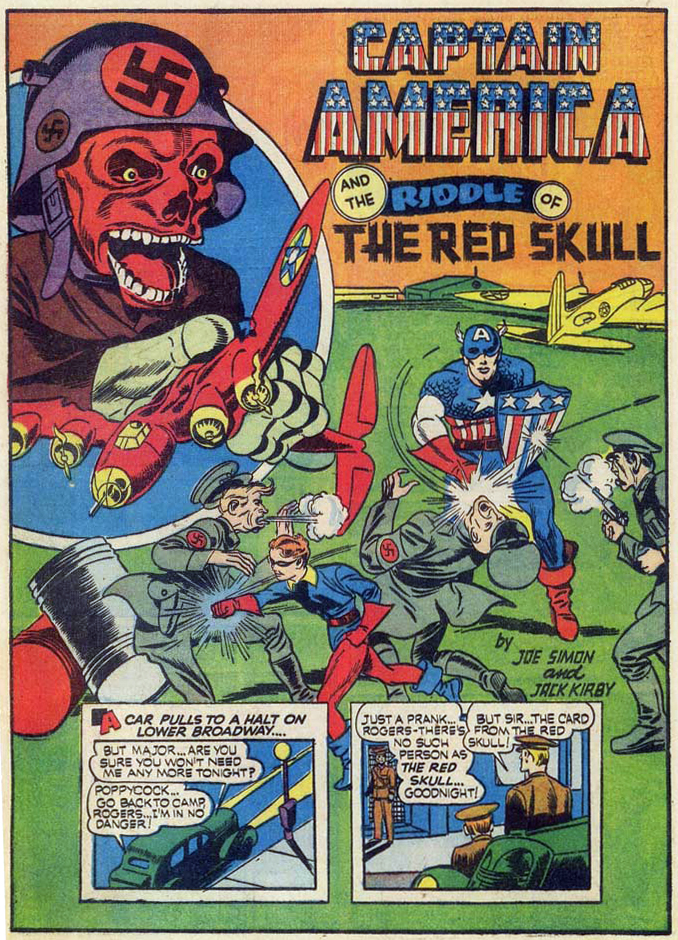
"Hurricane" appears to be the same character that originally appeared as "Mercury" in Red Raven Comics #1 (Aug/40). This may be an inventory story with the names changed that would then continue in the Captain America book as a new character up through issue #11. Most of the later non-Kirby stories were by Charles Nicholas Wojtkoski.


Marvel Mystery Comics #17 (Mar/41):
Jack likely penciled this story, perhaps with Simon assists, but I have no idea who inked it. I'd guess Joe Simon.


National Detective Cases Vol 1, #1 (Mar/41):
In addition to the justly important Captain America Comics #1, cover date Mar/41 is also important for another reason. Based on the success of two previously seen true-crime detective "flats", Martin Goodman now felt comfortable adding a third magazine, this time launched with Joe Simon as the Art Director at the onset. This was National Detective Cases. Goodman now had his "Big 3" up and running. The number would reach 11 by the decade's end.

The January, 1941 issue of Writer's Digest announced the magazine this way:
The Red Circle
group has just added a third member to its fact-detective publications. The new
one is National Detective Cases. To
start out, it will be a bi-monthly. However, it is quite likely that it may
soon shift dates to a monthly, as have the others of this group: Complete Detective Cases and Amazing Detective Cases. The new
magazine will follow the pattern set by those others as to general style of
make-up, editorial requirements, lengths, and rates of payments. Stories run
from 5,000 words, down, and there is always a need for short-shorts of 1500
words. Fact articles are about 500 words each. Cases must be completed through
the courts. A strong sex angle is preferred. Payment is two cents a word
minimum, on acceptance; $3 each for pictures, on publication. Robert E. Levee is editor of all three
fact-detective magazines for Red
Circle. Address – 330 West 42nd Street.
National Detective Cases Vol 1, #1 is a killer issue of a magazine. Three Jack Kirby illustrations (one cartoon) and a surprise photo!


In addition to the above, this issue also sports a staged photo with Joe Simon helping act out the scene!

After the immediate success of Captain America, the other somewhat expected shoe dropped. The partners at M.L.J Magazines were furious at what they perceived was the wholesale rip-off of their own patriotic character, The Shield. These three partners had a long history with Goodman in the industry. "M" was Maurice Coyne, "L" was Louis Silberkleit, and "J" was John Goldwater.
Maurice Coyne was an accountant of note and actually Martin Goodman's notary and accountant in the 1930's. Louis Silberkleit was the owner/Publisher of Columbia Publications, the parent company of MLJ. John Goldwater was also editor-in-chief of the comic book line. All three had their earliest days buried back in the pulp industry of the early 1930's. Goodman, Silberkleit and Goldwater had all worked at Eastern Distributing Corporation until the company went bankrupt in the fall of 1932. Contrary to Joe Simon's recollections, Goodman, Coyne and Goldwater did "not" form Columbia Publications immediately afterward. Goodman and Silberkleit formed Newsstand Publications in 1933 (and their own Mutual Magazine Distributors to distribute their pulps). In 1934 Mutual crashed and Silberkleit left on his own to form Winford Publications (which eventually would lead to Columbia becoming his parent company by the end of the 1930's). Goodman kept Newsstand Publications. John Goldwater's whereabouts is more difficult to track but he may have continued his association with Silberkleit at Columbia or as Simon recollected, may have been involved with Harry Donenfeld's Independent News, prior to re-joining Silberkleit at Columbia. And even before all that, Goodman and Silberkleit were employed at Hugo Gernsback's Experimenter Publishing Company until 1929, after which his bankruptcy forced their move to Eastern Distributing Corporation.
So when John Goldwater called Goodman, Simon and Kirby into his office with an official complaint about Captain America, their long history was already understood.
As recalled by Joe Simon, Goodman was unusually quiet at the meeting and the situation was settled by the changing of Captain America's shield from a triangle shape to a round shape. Simon additionally recalled Goldwater offering them a better deal than the one Goodman gave them, which riled Goodman to no end.
Maurice Coyne will come back into the picture shortly.
April, 1941:
A very busy cover month at Timely for Jack Kirby, appearing in more titles than any other month...
Captain America Comics #2
Marvel Mystery Comics #18
Daring Mystery Comics #7
Marvel Stories Vol 2, #3 (pulp)
Detective Short Stories Vol 3, #2 (pulp)
Uncanny Stories Vol 1, #1 (pulp)
Notable to me are the 3 pulp magazines filled with Jack Kirby illustrations. Too bad it wouldn't last.
Captain America Comics #2 (Apr/41):
Due most likely to the fact that he was so busy, the second issue of Captain America Comics does "not" feature a cover by Jack Kirby. This is certainly Joe Simon below.....


Cover: Joe Simon (?)
Cap story #1: "The Ageless Orientals Who Wouldn't Die! (15 p.) - Story by Simon & Kirby, pencils by Jack Kirby and Reed Crandall, inks by Reed Crandall and unknown.
Cap story #2: "Trapped in the Nazi Stronghold" (15 p.) - Story by Simon & Kirby, pencils by Jack Kirby and Reed Crandall, inks by Reed Crandall and unknown.
Cap story #3: "The Wax Statue that Struck Death" (15 p.) - Story by Simon & Kirby, pencils by Jack Kirby and Reed Crandall, inks by Reed Crandall and unknown.
Text story: "Captain America and his Boy-Pal Bucky in 'Short Circuit'" - script unknown, possibly Joe Simon, illustration unknown. (does not look like Jack Kirby to me).
Tuk, Cave Boy: "The Valley of the Mist" (6 p.) - script unknown but possibly Otto Binder (as per his records), artwork probably by Al Avison and Al Gabriele. Could be Gabriele with someone also.
Hurricane: "The Devil and the Green Plague" (10 p.) - Penciled, inked and lettered by Jack Kirby.
With this issue, the Simon and Kirby "shop" adds the talents of Reed Crandall. His fine, feathery inking graces all three stories. Al Avison and Al Gabriele also make appearances


Marvel Mystery Comics #18 (Apr/41):
Likely penciled and inked by Jack Kirby. Some Simon inks a possibility, especially on page 3.


Daring Mystery Comics #7 (Apr/41):
Appearing 7 months after issue #6, this title is now throwing anything out there with many Funnies Inc. features and this Simon & Kirby one-shot. (The character does appear one more time with a different artist). I'm not sure where this fits into the Kirby timeline but it looks like inventory to me. Something else about the splash also bothers me. The figure on the left is does not look like Jack Kirby's work. It looks like it could be Joe Simon. Captain Daring would return one last time next issue (in 9 months!) with artwork by Frank Borth Here, Jack may be inking himself with some Simon inking also.


Marvel Stories Vol 2, #3 (Apr/41): (cover by J.W. Scott)


This below looks like Joe Simon. I don't see any Kirby here.


Uncanny Stories Vol 1, #1 (Apr/41): (cover by J.W. Scott)
A proposed companion science-fantasy pulp to Marvel Stories, it never had a second issue.


This is probably Joe Simon, not Jack Kirby......

Signed again by Jack Kirby......


Detective Short Stories Vol 3, #2 (Apr/41): (cover by J.W. Scott)
A Jack Kirby bonanza! 12 illustrations and several of them are signed.


May, 1941:
Captain America Comics #3 (May/41):
Once again Jack Kirby is too busy both at Timely and elsewhere to draw this month's cover. The chore went to Timely's #1 cover artist, Alex Schomburg. Additionally, we have the very first appearance by office gopher and cousin-in-law to the publisher, Stanley Lieber, who writes this issue's text story under the pseudonym "Stan Lee".


The jam sessions get deeper as it appears Kirby begins doing layouts and some penciling on some stories. We can add Syd Shores, George Roussos, George Klein and Bernie Klein to the list of Simon & Kirby "shop" helpers this time.
Cover: Alex Schomburg
Cap story #1: "The Return of the Red Skull" (17 p.) - Story by Simon & Kirby, layouts and some pencils by Jack Kirby, Al Avison, inks by Kirby, Simon, George Klein and unknown.
Cap story #2: "The Hunchback of Hollywood and the Movie Murder" (17 p.) - Story by Simon & Kirby, layouts and pencils by Jack Kirby and unknown, inks by Simon, Kirby, George Klein, George Roussos, Bernie Klein and Syd Shores.
Text story: "Captain America Foils the Traitor's Revenge" - Script by Stan Lee, illustration by Jack Kirby.
Cap story #3: "The Queer Case of the Murdering Butterfly and the Ancient Mummies" (11 p.) - Story by Simon & Kirby, layouts and pencils by Jack Kirby and unknown, inks by Reed Crandall with George Klein, Al Gabriele and unknown.
Tuk Cave Boy: "Atlantis and the False King" (6 p.) - script unknown but possibly Otto Binder (as per his records), artwork attributed to Mac Raboy.
Amazing Spy Adventures: "The True Story of the Bald Head Message" (2 p.) - script and art by Jack Kirby.
Hurricane: "Satan and the Subway Disasters" (7 p.) - Penciled, inked by Charles Nicholas Wojtkoski


Marvel Mystery Comics #19 (May/41):
Jack Kirby pencils, unknown inks. I'd could guess Syd Shores but it's only a guess.


Zippy Vol 1, #1 (May/41):
In mid 1940 Martin Goodman branched out into the area of bedsheet-sized girly humor and cartoon magazines like College Humor (published by Collegian Press, Inc.). His first release was Snap (Aug/40) followed by Zest (Mar/41, then Zippy (May/41). 4 more titles would follow (Jest, Gayety, then digests Joker and Comedy... all being sort of Humorama prototypes) and I will cover them all in a future article. For our purposes, Zippy Vol 1, #1 sported a dynamite Joe Simon cover and inside is a cartoon mentioning Jack Kirby as a tattoo artist! The actual artist here could be Harry Douglas, who was the editor of Zest (and possibly Zippy also). Unfortunately, while Snap, Gayety and Jest had decent runs through 1943, Zippy lasted but a single issue.


National Detective Cases Vol 1, #2 (May/41):
Signed by Jack Kirby!


June, 1941:
Captain America Comics #4 (June/41):
Once again Jack Kirby is too busy to render this month's cover. The chore went again to Timely's #1 cover artist, Alex Schomburg.


Cover: Alex Schomburg
Cap story #1: "The Unholy Legion" (19 p.) - story by Simon & Kirby, Kirby splash, story pencils by Al Avison, inks by Al; Gabriele, Syd Shores (?) and George Klein (?)
Cap story #2: "Ivan the Terrible" (9 p.) - story by Simon & Kirby, pencils by Jack Kirby, inks by Joe Simon, Al Gabriele (?), Syd Shores (?), Joe Simon (?) and Jack Kirby (?)
Cap story #3: "The Case of the Fake Money Fiends" (10 p.) - story by Simon & Kirby, possibly layouts by Jack Kirby, pencils by Al Avison and Fred Bell (?), inks by unknown
Cap story #4: "Horror Hospital" (13 p.) - story by Simon & Kirby, possible layouts by Jack Kirby, splash looks like Joe Simon, pencils by Al Avison and Al Gabriele (?), inks by Simon (?), Avison (?), Gabriele (?) and George Klein (?).
Text story: "Captain America and the Bomb Site Thieves" - script by Stan Lee, illustration by Jack Kirby.
Tuk Cave Boy: "The Ogre of the Cave Dwellers" (6 p.) - pencils unknown, like Al Gabriele inks.
Hurricane: "The Pirate and the Missing Ships" (7 p.) - penciled, inked by Charles Nicholas Wojtkoski


Marvel Mystery Comics #20 (June/41):


Amazing Detective Cases Vol 1, #5 (June/41):
Signed by Jack Kirby.


Complete Sports Vol 3, #2 (June/41): (cover by J.W. Scott)


Summer, 1941:
There are two additional titles to mention. Cover month Summer/41 saw the release of All Winners Comics #1 and Young Allies Comics #1. Both were overseen by Joe Simon.
All Winners Comics #1 (Summer/41): Captain America story, "The Case of the Hollow Men" (13 p.), produced by Simon & Kirby, splash page penciled by Jack Kirby, inks likely by Joe Simon. The rest of the story looks like S&K shop with Al Avison, Al Gabriele, et al.

Young Allies Comics #1 (Summer/41): Produced by Simon & Kirby, this 57 page story is broken up into 6 chapters with the majority of the penciling done by Charles Nicholas Wojtkoski. The chapter 2 and 3 splashes are Kirby-esque but I'm doubting his involvement outside of layouts.
Other than a possible Simon & Kirby layout, I don't really see any evidence that Jack Kirby penciled the cover below.

Here are the chapter 2 and 3 splashes. Again, very Kirby-esque but how much is actual Kirby and how much is layout is unknown.


July, 1941:
Captain America Comics skips a month for July, the only month it will miss until #41 (Aug/44), after which it goes bi-monthly (and occasionally monthly) until the end of the run.
Marvel Mystery Comics #21 (July/41):
This looks like Kirby with Al Avison. Probably some Joe Simon inking also.


Complete Detective Cases Vol 3, #4 (July/41):
Signed by Jack Kirby.


National Detective Cases Vol 1, #3 (July/41):


August, 1941:
Captain America Comics #5 (Aug/41):


Cover: Jack Kirby pencils, Joe Simon inks
Cap story #1: "The Ringmaster of Death" (12 p.) - story by Simon & Kirby, Kirby/Simon splash, pencils by Kirby, Avison, inks by Syd Shores (?), George Klein (?).
Cap story #2: "The Gruesome Secret of the Dragon of Death" (15 p.) - story by Simon & Kirby, Kirby splash, Kirby, Avison pencils, inks by Syd Shores (?), George Klein (?).
Cap story #3: "Killers of the Bund" (10 p.) - story by Simon & Kirby, splash by Kirby, pencils by Kirby, Avison, Simon (?)and Mort Meskin (?), inks by Joe Simon and Jack Kirby (?).
Text story: "Captain America and the Ruby Robbers" - script Stan Lee, illustration Jack Kirby
Cap story #4: "The Terror that was Devil's Island" (6 p.) - story by Simon & Kirby, splash by Kirby/Simon, pencils by Avison & Simon (?), inks by Simon (?) and George Klein (?).
Headline Hunter: script by Stan Lee, art possibly Harry Fisk (?) but generally unknown.
Tuk Cave Boy: Kirby/Simon splash, Avison (?) / Gabriele (?) story art.
Hurricane: Pencils and inks by Charles Nicholas Wojtkoski
As mentioned above, now added to the list of Simon & Kirby "shop" participants is Mort Meskin.


Marvel Mystery Comics #22 (Aug/41):
Jack Kirby renders the splash page but the rest of the story looks mostly Al Avison with inkers, possibly Joe Simon on some pages. Kirby may have also done layouts for Avison. The last 2 pages look markedly different.


USA Comics #1 (Aug/41):
Produced by Simon & Kirby, this first issue is a package of divergent characters :
The Defender - an unused Avison and Gabriele Captain America story re-formatted as a new character.
The Whizzer - Avison/Gabriele
Mr. Liberty -Syd Shores / George Klein
Rockman - Basil Wolverton story and artwork (new splash by Charles Nicholas Wojtkoski)
Young Avenger - Howard Purcell
Jack Frost - Stan Lee script, Charles Nicholas Wojtkoski pencils/inks.
The Jack Frost story above has the distinction of being the very first comic book story by Stan Lee. There have been threes stories appearing at nearly the same time that have vied for this distinction. Headline Hunter in Captain America Comics #5 (Aug/41) has long been thought of as Stan's first. Several years back I solved this mystery and have refuted the Cap #5 story. Based on Copyright Registration data, the 3 stories shake out this way:
USA Comics #1 (Aug/41) - "Jack Frost" - May 15, 1941
All Winners Comics #1 (Summer/41) - "Black Marvel" - May 19, 1941
Captain America #5 (Aug/41) - "Headline Hunter" - May 27, 1941
So USA Comics #1 and the Jack Frost story is Stan Lee's very first comic book story.
The cover to this issue is all that Jack Kirby seems to have been involved with. Looks like Kirby/Simon to me.

September, 1941:
Captain America Comics #6 (Sept/41):


Cover: Kirby / Simon.
Cap story #1: "Battles the Camera Fiend and his Darts of Doom" (16 p.) - story by Simon & Kirby, Kirby/Simon splash page, Al Avison pencils, Gabriele (?), Shores (?) inks.
Cap story #2: - "Meet the Fang, Arch Fiend of the Orient" (9 p.) - story by Simon & Kirby, Kirby/Simon splash page, Al Avison pencils, Syd Shores (?), George Klein (?) inks.
Father Time: "The Grim Reaper Deals With Crime" (6 p.) - script by Stan Lee, pencils by Al Avison, inks by Al Gabriele
Cap story #3: "The Strange Case of Capt. America and the Hangman (16 p.) - story by Simon & Kirby, Kirby/Simon splash page, pencils by Jack Kirby (?), Al Avison (?), inks by George Klein (?) and unknown.
Text story: "Trap for a Traitor" - Stan Lee script, unknown art.
Headline Hunter: "Battles the Engine of Destruction" (5 p.) - unknown art but could be Harry Fisk (?).
Hurricane: art by Charles Nicholas Wojtkoski


Incredibly, the original Kirby/Simon art to this glorious splash page has miraculously survived these 76 years!!!

The very first double-splash page in this title! This is the first of many, many such "wide-screen" splashes to come!!

At this point, it's important to note that Jack Kirby is really only drawing the splash pages (and what splash pages they were!!!) and at the most, partially laying out the stories for pencilers like Al Avison. Now more than ever, the production is an assembly-line process with any and all filling in where needed.
Marvel Mystery Comics #23 (Sept/41):
A Kirby/Simon splash and a Kirby and someone else penciled story, maybe Simon, maybe Al Avison. Likely Simon inks over it all.


Just for kicks, this issue sported a Vision text story by Stan Lee. The art is initialed what looks like "W.E.B." and I haven't been able to figure out who this is. ......


Fall, 1941:
All Winners Comics #2 (Fall/41):
Captain America story: "The Strange Case of the Malay Idol" (12 p.) - Kirby/Simon splash page and Al Avison pencils with Gabriele (?), Shores (?) inks.

October, 1941:
Captain America Comics #7 (Oct/41):


Cover: Kirby/Simon
Cap story #1: "The Case of the Red Skull and the Whistling Death" (13 p.) - Simon & Kirby story, Kirby/Simon splash, Kirby layouts, pencils, with Avison and possibly Fred Bell also penciling, Simon and unknown inks.
Cap story #2: "The Case of the Baseball Murders" (15 p.) - Simon & Kirby story, Kirby/Simon splash, pencils by Kirby and Avison, inks by Simon and Syd Shores (?)
Text story: "A Message from Captain America" - script by Stan Lee, art unknown.
Cap story #3: "Horror Plays the Scales" (13 p.) - Simon & Kirby story, Kirby/Simon splash, Al Avison story pencils, Charles Nicholas Wojtkoski inks
Hurricane: "Justice Laughs Last" (7 p.) - Ken Bald / Bill Ward (Binder shop story, it seems)
Headline Hunter: "Dust of Destruction" (5 p.) - script by Stan Lee, art unknown but possibly Harry Fisk (?)
Father Time: "Race Against Doom" (7 p.) - Avison / Gabriele with Chu Hing (?)


Marvel Mystery Comics #24 (Oct/41):
Minimal to no Kirby involvement. Possibly the splash is Kirby/Simon but then again the only thing that looks like Kirby is the armored villain on the right. Nothing else. It's possible Kirby broke these Vision stories down for whoever was penciling them now, keeping a consistent action/adventure storytelling flow.


November, 1941:
Captain America Comics #8 (Nov/41):
No Kirby. This cover is seemingly by Al Avison and Al Gabriele. Simon is a possibility also in some caopacity.


Cover: Al Avison / Al Gabriele (and/or Joe Simon).
Cap story #1: "The Strange Case of the Ruby of the Nile" (13 p.) - Simon & Kirby story, Kirby/Simon splash, Kirby layouts, Avison, Charles Nicholas Wojtkoski (?) pencils, Syd Shores, Al Gabriele, George Klein inks.
Cap story #2: "Murder Stalks the Maneuvers" (11 p.) - Simon & Kirby story, Kirby/Simon splash, Kirby layouts, Al Avison pencils, Syd Shores (?), George Klein inks.
Headline Hunter: "The Plague of Death" (5 p.) - Stan Lee script, unknown art (could be Harry Fisk).
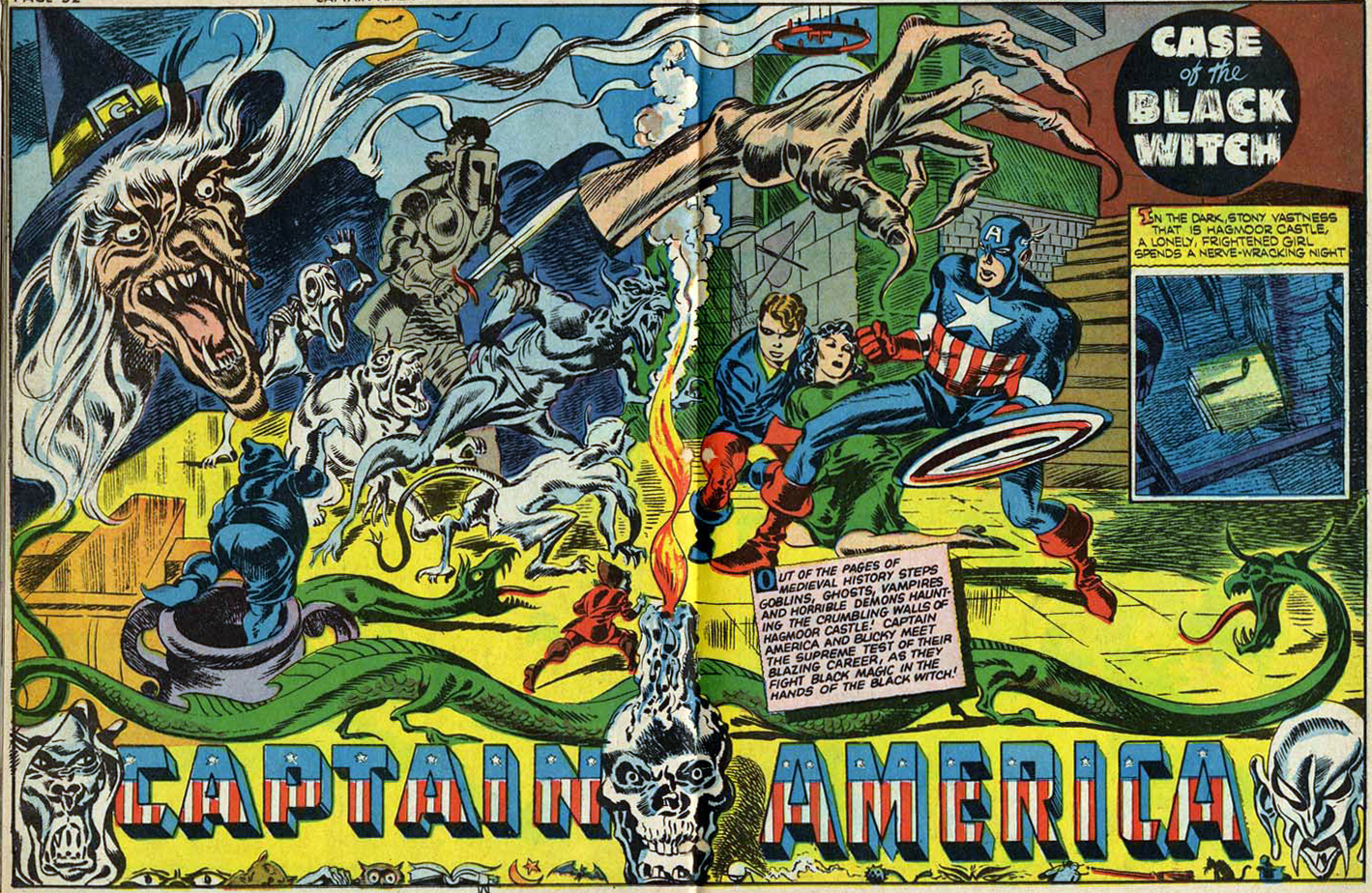
Cap story #3: "Case of the Black Witch" (17 p.) - Otto Binder script, Simon & Kirby story, Kirby/Simon splash, pencils by Avison and Ernie Hart (?), inks by Al Gabriel (?), Syd Shores (?) and George Klein (?).
Hurricane: "Carnival of Crime" (7 p.) - Charles Nicholas Wojtkoski pencils, inks.
Text story: "Young Allies Deal a Blow for Justice" - Stan Lee script, unknown art.
Father Time: "Vault of Doom" (7 p.) - Al Avison pencils/inks.
Add Ernie Hart to the growing list of Simon & Kirby "shop" assistants.


Marvel Mystery Comics #25 (Nov/41):
Likely a Kirby splash but the rest is seemingly not Kirby. I see Al Avison, Ernie Hart and I believe even Mike Sekowsky in this story.


December, 1941:
Captain America Comics #9 (Dec/41):


Cover: Kirby/Simon
Cap story #1: "Captain America and the White Death" (11 p.) - Simon & Kirby story, Kirby/Simon splash, Kirby, Avison and Mike Sekowsky (?) pencils, inks by George Klein and unknown.
Cap story #2: "Captain America and the Man Who Could Not Die" (13 p.) - Simon & Kirby story, Kirby/Simon splash, Kirby layouts (?), Al Avison pencils, inks by George Klein, Syd Shores (?) and Joe Simon.
Headline Hunter: "Death in the Alps" (5 p.) - Stan Lee script, art unknown (may be Harry Fisk).
Text story: "Dead Man's Ring" - script by Stan Lee
Cap story 3: "Captain America in the Case of the Black Talon" (18 p.) - script by Otto Binder, Simon & Kirby story, Kirby/Simon splash, Kirby, Avison pencils, inks by Shores, Klein and unknown.
Hurricane: "Crime Goes to Press" (7 p.) - art by Charles Nicholas Wojtkoski
Father Time: "The Bombs of Doom" (7 p.) - pencils by Al Avison, inks by George Klein and unknown.


Marvel Mystery Comics #26 (Dec/41):
Maybe no Kirby at all on the splash but included to see. The story is primarily Avison and I see Ernie Hart, Charles Nicholas Wojtkoski and George Klein.


January, 1942:
Captain America Comics #10 (Jan/42):


Cover: Kirby / Simon
Cap story #1: "Captain America and the Spy Ambush" (11 p.) - Simon & Kirby story, Kirby/Simon splash, Kirby and Avison (?) pencils, inks by George Klein and unknown.
Cap story #2: "Captain America and the Hotel of Horror" (13 p.) - Simon & Kirby story, Kirby/Simon splash, Avison and unknown pencils, Syd Shores, George Klein and unknown inks.
Headline Hunter: "Uncovers a Sinister Scoop" (5 p.) - script by Stan Lee, art unknown (may be Harry Fisk).
Text story: "All in a Day's Work!" - script by Stan Lee.
Cap story #3: "The Phantom Hound of Cardiff Moor" (16 p.) - Simon & Kirby story, Kirby/Simon splash, Kirby and Avison, inks by Shores, Klein and unknown.
Hurricane: "The Skyscraper Plot" (7 p.) - art by Charles Nicholas Wojtkoski.
Father Time: "The Man Who Could Forcast Doom" (7 p.) - Avison / Klein is best guess


In the splash above you can make out names sneaked into the "register of death".... "M. Sekows" (Sekowsky), "Leeman" (Lee) "Shires" (Shores), "B. Kingo" (King), "A Kuppler" (Kugelmass?) and a few others I cannot identify.
Add Bill King (likely in production) and Mike Sekowsky to the Simon & Kirby "shop". J. Alvin Kugelmass was a writer and editor for the magazine side of the company. He recently had absconded with checks for authors and eventually went to prison. Read about it (HERE)

Marvel Mystery Comics #27 (Jan/42):
Kirby-esque splash and story art heavily inked by George Klein. The splash is not inked by Klein. It could be Simon. The main penciler eludes me and it's driving me crazy because he's all over concurrent Captain America stories (and I don't think it's Al Avison). Also there looks like more than one penciler here.Page 5 and 6 look like somebody completely different from the rest of the story. I wonder if this is Gil Kane? Likely nothing at all Kirby in this story. After this even a hint of Kirby is completely gone from The Vision series.


And then they were gone. Just like that. Let's stop and backtrack now. What happened? Why weren't there years and years of Timely comic books, characters and creations by the Simon & Kirby team? The answer is simple and quite sad, but not unexpected, given the rat-race, dog-eat-dog world of cheap newsstand publishing.
Let's go back to the initial enormous success of Captain America Comics #1. It surpassed all expectations. As the following issues continued to sell like wildfire, Simon and Kirby were a hit machine and began to wonder when all the royalties (a 25% stake) they were promised by Martin Goodman would materialize. They certainly confronted the publisher at some point but were mostly rebuffed. As their concern began to grow and grow, it was Maurice Coyne who had the answer. Recall that Maurice Coyne was Goodman's accountant and notary. Maurice Coyne was "also" a partner in M.L.J. Magazines, the comic book wing of Columbia Publications (which would shortly in a few years be called Archie Comics).
Coyne told Joe Simon that Goodman was putting all the company's expenses on Captain America Comics. So after deducting all expenses across the line, .... there were no profits! I don't even think "livid" properly describes what Simon and Kirby were likely feeling. Perhaps they were tired of running the creative end of the company or felt there was no future under such baldfaced dishonesty, the end result was Simon and Kirby made the decision to leave, contacting DC Comics, who immediately offered them a huge raise and offers of unlimited work under their byline.
The decision made, they began to work off-site on material for Harry Donenfeld while still working for Timely At some point, Stan Lee noted that something was up between the duo. As they were working on Captain America #10, they were finally confronted by the Goodman brothers Martin, Abe, David and Robbie Solomon... really, the entire family hierarchy of the company. They fired Simon & Kirby on the spot for disloyalty and insisted they complete issue #10 before they left, which was easily done. I believe to his dying day Jack Kirby suspected it was Stan Lee who ratted them out. Joe Simon, not so much.
In looking back at what Maurice Coyne told Joe Simon, a couple of things are considered. Up to this point "all" of Goodman's comic book titles were published under the entity Timely Publications (except for Popular Digest, which I showed "became" Captain America Comics Vol 2, #1).
Immediately following the publication of issue #1, Goodman changed all of his ongoing comic book sub-publishers to Timely Comics, Inc. (completely dropping Timely Publications) then immediately launched All Winners Comics, USA Comics and Young Allies Comics with different new publishing entities, U.S.A. Comics Magazine Corp. Tie this to Goodman claiming there were no profits on Captain America Comics and his immediate change of publishing entity after the first issue.
Is there a significance to this? I'm not certain. Someone better versed in legal accounting measures may see something there. Or maybe not. But the bottom line was that Goodman took advantage of Simon and Kirby. He offered them royalties, they provided success, and then he took the position to screw them. It cannot be explained away that it was "legal" for him to do so (if it actually was, a verbal agreement is still an agreement), it was morally reprehensible and was quite simply, greed. But that was the dog-eat-dog world of cheap newsstand publishing (and the music and film industries). Greed.
Additionally, it always seemed strange that Maurice Coyne was Goodman's accountant (and privy to his financial details) and his warning Joe Simon about the accounting shenanigans while also a partner in a rival comic book company, M.L.J. Magazines. What was his angle on this? Simon has speculated it was to possibly drive Simon & Kirby to M.L.J. Given that Coyne knew about Silberkleit's past history partnership with Goodman at Newsstand Publications in 1933-34, it is a likely scenario. I've always gotten the feeling there was forever ongoing animosity between Goodman and Silberkleit, first over their break-up, then with the Mutual Magazine Distribution lawsuits (their shared distribution company), their being raked over the coals by the F.T.C., and then over Captain America's similarity to The Shield. I've always felt they were now bitter rivals. (Goodman may have even agreed to Frank Torpey's suggestion to try comic books because he had known about Silberkleit's upcoming initial entry Blue Ribbon Comics, which beat Goodman to the stands by one month). I also bet it was Maurice Coyne, as a friend to both, who brokered the settlement on changing the shield from triangular to round, convincing Silberkleit not to go the legal route, with the unspoken thought that since he knew Goodman was screwing them, he might convince them to join M.L.J. The fact they jumped to DC instead may have further enraged Silberkleit. But that's all speculation on my part.
Al Avison would take over Captain America completely with Al Gabriele and eventually Syd Shores inking. When Avison left Syd Shores would assume the mantle of longest running Captain America artist throughout most of the decade.
Simon & Kirby went on to enormous continued success at DC and Kirby would go on to be the greatest creator the industry would ever see. He would return to Martin Goodman and Stan Lee in 1956 looking for work, but that's a story for another time.
A happy 100th birthday to the literal "King" of comics, the incomparable Jack Kirby.
SOURCES:
- Simon, Joe. "My Life in Comics"; Titan Books, 2011
- Bell, Blake and Dr. Michael J. Vassallo. "The Secret History of Marvel Comics"; Fantagraphics Publishing, 2013
- Thank you to Cory Sedlmeier for tons of Timely scans. I could not do this as thorough as I did without him!
- All pulp and magazine scans are from the author's collection.
- Thanks to Nick Caputo for a rousing back and forth discussion on inkers!


%20fix.jpg)


