Begun as a blog to unload (or upload) all the information I'd accumulated in my decades of research into Martin Goodman and all his published product ... comic books, pulps, magazines and digests, I've often veered here into my other obsession, the history of the New York Sunday News comics. At the age of 56, I'm still knee-deep in both worlds of research, even moderating two Facebook groups devoted to each topic. This post will happily merge the two, in a way of sorts. Comic Books and Sunday Comics. You'll see what I mean below as there's always a method to my madness.
The mechanism of the merger is the name well known to all of us as the single most important name in the history of commercial comic books, Jack Kirby. Yes, I know there are many seminal names of importance... there are publishers, there are artists and writers, innovators, etc... .the list is long: Just a handful would include Major Malcolm Wheeler-Nicholson, Jerry Siegel and Joe Shuster, Will Eisner, Carl Barks, Bill Finger, Jerry Robinson, Sheldon Mayer, Max Gaines, Bill Gaines, Stan Lee, Joe Simon,Wally Wood, EC, DC, Marvel, etc, et al.... we can go on for quite a while and I don't want anyone feeling I left out their favorite candidates. Each of those creators, companies and more have done something crucially important in comics history and they are all vital. I can't name them all here. My candidate is Jack Kirby. Commercial action/adventure/hero comic books begin and end with Jack Kirby. If I have to explain it, move on to another blog. I covered Jack Kirby's entire history at Timely Comics HERE on the occasion of his 100th birthday. This Timely/Kirby history is important as I unravel my story today.
So what does Jack Kirby have to do with the New York Sunday comics? I'm getting to it. For years I've been building a near 100 year database on the NY Sunday News comics, a newspaper that was founded by publisher Joseph Medill Patterson in 1919. The index is probably 65% to 70% complete over the course of a century. You want to know when a particular strip began or stopped, I can probably tell you, or at the very least narrow it down closely to the month, often the exact week. My favorite aspects are not the well-known standards of the comic pages, but instead the short-run strips and the strange and elusive fillers! (That's a blog post in the making). Strips that appeared and vanished into the ether, never to be seen again or reprinted. The News was full of them as they had their own New York News Syndicate that produced strips "only" for this one paper. That means if you didn't read the NY Sunday News, you never saw those comic strips. That's the full type of data I'm archiving and scanning. It's a lot of fun, it takes a lot of time and it also takes a lot of paper! My data is not mined from online sources, nor books, nor hearsay. It comes from my own observation of the actual Sunday newspaper comic sections I have in my own possession. And for this I have two sources. The first is my near-complete collection of Sunday sections I've saved from about 1968 to present. The second is from newspaper dealers all over the country (actually, the world, as I've bought NY News Sunday comics sections from as far away as South Korea!) that have taken my collection back to 1924 (as of this writing).
So yeah, I spend all my free time immersed in newsprint, either the 10 cent four-color stapled variety, or the tabloid-sized folded variety.
So yeah, I spend all my free time immersed in newsprint, either the 10 cent four-color stapled variety, or the tabloid-sized folded variety.
My focus has always been on complete Sunday sections. I need to know what's inside and their order. And also the ads (another blog post for the future). I really cringe at strip dealers that have cut up collections to put runs together of favorite strips. It's been going on for decades and I realize it has its place for strip collectors. I have bought strip collections this way in the past on certain strips. But the idea of cutting up a complete vintage Sunday section is and will always will be abhorrent to me.
Recently I acquired a large collection of "incomplete" Sunday sections. Historically, I avoid these because they don't suit my needs of collecting data from complete sections. But this time I gave in. The collection was a large collection of 1940's and 1950's "incompletes." Going through the pile I was happy to see that there were actually 2 complete sections, unbeknownst to the seller. Additionally, there was a section missing a centerfold and incredibly, I had a loose centerfold for that same week bought the year before that matched up perfectly! I kid you not. There's an outside chance the seller was the same and this is the actual missing centerfold from that exact Sunday section, somehow separated long ago and sold years apart to the same buyer, namely me. And lastly, there were tons of miscellaneous half-sections, 4-side outer wraps and 4 side interior pages.
One such half-section was from 1957. The original section was 16 pages long. This was the first 2 wraps, a total of 8 pages. Now I'm not a fan of the later 1950's NY Sunday News comics. Except for the last 20 years, it's my least favorite period. Long-running features from the 1930's were winding down in quality. There was the occasional uninspired feature added but the stable was the same. The 1960's, particularly after the newspaper strike of 1962-63, injected new life into the NY Sunday News as orphaned strips from the NY Sunday Mirror made their way over, including Li'l Abner, Louie, Kerry Drake and Rex Morgan M.D. (In addition, short runs from The Mirror included Joe Palooka, Mickey Finn, Henry, Apartment 3-G and Dan Flagg. But that's a blog post for another time.) Likewise, by 1967, strips from the defunct Journal-American would join the paper, titans of the Sunday comics including Chic Young's Blondie and Mort Walker's Beetle Bailey.
So 1957 was somewhat predictable, Sunday comics-wise, in the NY Sunday News. A typical Sunday section would start off with Chester Gould's Dick Tracy, Harold Gray's Little Orphan Annie, George Wunder's Terry and the Pirates and then either Dale Messick's Brenda Starr Reporter or Ferd Johnson's Moon Mullins. The back page was always Bill Perry's Gasoline Alley and inside you'd find a full-tab Dondi by Gus Edson and Irwin Hasen. (Dondi didn't get the back cover until after the newspaper strike in 1963).
The rest were old News icons like Walter Berndt's Smitty, Martin Branner's Winnie Winkle, William Donahey's The Teenie Weenies, Stanley Link's Tiny Tim (which ended with Link's death on Christmas eve), Bill Holman's Smokey Stover, Al Posen's Sweeney & Son, Jay Irving's Pottsy, Timmy by Howard Sparber and Smilin'Jack by Zack Mosley. Fillers, depending on the ad space being sold, could be a compilation of Reamer Keller spot gags, Gill Fox's Bumper to Bumper, or one of several fillers by Henri Arnold, This Man's Army or Bibs 'N' Tucker.
And, of course, there were the Westerns. In the 1950's, there always were Westerns! A staple of early television and film, Westerns were rampant across entertainment media. The early 1950's saw the best one, Hopalong Cassidy debut by Dan Spiegle. This was one beautiful Sunday strip that resonated with all the colors of the West. I don't know if it ever was reprinted but I'm going to highlight it here in the future. Late 1957 saw the launch of Jed Cooper, American Scout by Rick Fletcher in this paper (It began in 1949 elsewhere, running until 1961).
The rest were old News icons like Walter Berndt's Smitty, Martin Branner's Winnie Winkle, William Donahey's The Teenie Weenies, Stanley Link's Tiny Tim (which ended with Link's death on Christmas eve), Bill Holman's Smokey Stover, Al Posen's Sweeney & Son, Jay Irving's Pottsy, Timmy by Howard Sparber and Smilin'Jack by Zack Mosley. Fillers, depending on the ad space being sold, could be a compilation of Reamer Keller spot gags, Gill Fox's Bumper to Bumper, or one of several fillers by Henri Arnold, This Man's Army or Bibs 'N' Tucker.
And, of course, there were the Westerns. In the 1950's, there always were Westerns! A staple of early television and film, Westerns were rampant across entertainment media. The early 1950's saw the best one, Hopalong Cassidy debut by Dan Spiegle. This was one beautiful Sunday strip that resonated with all the colors of the West. I don't know if it ever was reprinted but I'm going to highlight it here in the future. Late 1957 saw the launch of Jed Cooper, American Scout by Rick Fletcher in this paper (It began in 1949 elsewhere, running until 1961).
And in between the two, there was Davy Crockett, Frontiersman by Jim McArdle and then Jim Christiansen, syndicated by Columbia Features, Inc.. Writing on this strip was France Edward Herron.
Interlude:
Eddie Herron broke into the comics business at the Harry A. Chesler shop in 1937, producing work for Centaur Comics. In 1939 he was at Fox where he ran into Joe Simon and Jack Kirby, who later hired him to work on the earliest issues of Captain America Comics for Timely by way of the informal Simon & Kirby "shop" that packaged the first 10 issues of the title. It was at Timely where Eddie Herron became known, according to Jack Kirby, as the "father of the Red Skull", creating the character for the first issue of the book. Herron would then move over to Fawcett Comics and co-create Captain Marvel Jr. with Mac Raboy.
After the War, Herron began a long writing tenure with DC comics up through the early 1960's. He was there when Jack Kirby launched Challengers of the Unknown, later even writing the feature, and later joined his old colleague Joe Simon at Harvey in 1966, the year of his death.
In 1955, Herron began writing the Davy Crocket, Frontiersman newspaper strip. Crockett mania had exploded across the country after the success of Walt Disney's 1954-55 TV show (a total of only 5 episodes). The first artist on the strip was Jim McArdle and his work was servicable, if pedestrian. A Funnies Inc. alumnus of the early 1940s, McArdle made his way around the industry in the 1940's and 1950's doing a lot of work at DC in the 1950's, titles including Gang Busters, House of Mystery, House of Secrets, Star Spangled Comics.and Our Army at War. By 1957 the mania was stalling and on Sunday February 24, 1957 a ghost artist substituted for McArdle.
End of Interlude
As I made my way through the pile of "incomplete" Sunday sections, as I mentioned, I landed on a half section from early 1957. Only the two outer wraps were extant. Paging through I felt it would be a good idea to scan the entire section for my files. Who knew how long it would take to eventually find an intact section. Historically, I scanned only my favorite strips but over the last few years, I've come to understand that I should have been scanning "every" strip for posterity. One strip I did not scan was Davy Crockett, Frontiersman. In fact, I didn't have a single representative of this strip in my digital files (although I had over 30 paper original Sunday strips in complete Sunday sections). The strip only ran about two years and I believe ended this very year. I just didn't like westerns in general, or this strip in particular. The art was uninspired and the only thing to ever catch my eye was the Timely-tinged name Eddie Herron in the first panel, a name I knew, as mentioned, had created the Red Skull for Simon & Kirby.
I begin scanning.... First Dick Tracy and then Little Orphan Annie on the reverse. I then jump to the back page and scanned Gasoline Alley followed by full tab page Terry and the Pirates, and Moon Mullins. Back to half tabs Pottsy, Smitty, Teenie Weenies, Tiny Tim and Smokey Stover. And that was it. Missing from the two lost interior wraps were Winnie Winkle, Smilin' Jack, Sweeney & Son, Brenda Starr Reporter, Timmy and Dondi.
Oh, also there was Davy Crocket, Frontiersman, but already seen, I never scan this feature. Then briefly glancing at the strip, I thought maybe I'd scan it this one time and have at least one Sunday section for my files. So without too much thought, I place it down on the scanner bed and scan the strip. Usually I don't pay too much attention to an image as it slowly appears across my computer screen during a scanning, but the slow creep at 300 dpi caught my attention. As the image loaded the art really jumped out at me and I was struck at how bold it was. It was real good, better than I'd ever noticed before on this feature. The characters stood nobly at attention and struck very "familiar" poses, as something strangely gnawed at the back of my head. Wait a minute, it couldn't be.... I grabbed the Sunday section off the scanner bed and look at it closely. THIS WAS JACK KIRBY!!!
Jack Kirby??? Was this possible? Did I ever hear about this before? I wracked my brain, recalling that he had ghosted Johnny Reb for Frank Giacoia for a few strips. This was about the same time as that, so it certainly was possible. Of course it was possible! My eyes don't lie!. A search online turned up a reference to this in a post on the Jack Kirby Museum site HERE. The author relates a search after Kirby Davy Crockett French reprints surfaced, and comparison to Kirby's Davy Crockett work for Harvey Comics, and that he ghosted the newspaper strip for 3 weeks, with the further comment that it was unknown or even doubtful that Kirby had done the Sunday strip in that time.
Well, I can answer that question... He did! February 24, 1957 in the NY Sunday News comics......

My feeling here is that he likely inked this himself and truthfully, I don't know if he did the following week also.I don't have the following week's Sunday section.
*** (6/21/18 addendum ... Jack Kirby "DID" draw the following week also, March 3, 1957!!!!!!)

The circumstances that lead up to this "ghosting" of the strip are speculation but Kirby's long-time relationship with Eddie Herron probably had a lot to do with it. Losing work after Martin Goodman lost his distributor in the Spring of 1957 certainly led to seeking other avenues of income. Kirby lost both the Yellow Claw feature and a newly launched Black Rider comic book. Scrambling for work, Kirby and Herron hooked up in some capacity leading to a tenure of about 3 weeks on the Davy Crockett strip, including at the very least, this Sunday page. Later, of course, Jack Kirby would launch his own Sky Masters newspaper strip in 1958 with Dave Wood, lasting through 1961.
Following this short sojourn by Jack Kirby, the art chores were taken over by Jim Christiansen, who I felt better suited to the feature than McArdle. Trained in the Tom Gill studio on The Lone Ranger comic book for Dell, Christiansen also drew the Nero Wolfe comic strip for the same Columbia Features, Inc. syndicate. The Tom Gill influence is very evident on his pages, so much so it makes me wonder if Gill's hand is here in some capacity.
The New York Sunday News ran their last Davy Crocket, Frontiersman Sunday on August 25, 1957. The strip was replaced the following week by Leonard Starr's masterpiece, On Stage. It's alleged that Davy Crockett lasted elsewhere as late as 1959 but I do not have corroboration on this. If anyone has further data on that, I'd be extremely appreciative if you could please pass that information on to me
Here is the rest of the aborted, truncated, half-section off the pile of "incompletes". At the very end afterwards I will also present my collection of Davy Crockett Sundays by McArdle and Christiansen (and Jack Kirby). The collection is not complete but consists of the 56 Sundays I've been able to acquire.
New York Sunday News Comics of February 24, 1957 (truncated half-section) :
*** (6/12/18 addendum, the 5 missing strips of the truncated section have been added below)


And finally, my 56 Sunday collection of DAVY CROCKETT, FRONTIERSMAN, stretching from November 6, 1955 to the final Sunday carried by the NY Sunday News, August 25, 1957. The very next week it was replaced by Leonard Starr's ON STAGE.


November 20, 1955

January 1, 1956

January 8, 1956

January 15, 1956

January 22, 1956

January 29, 1956

February 5, 1956

February 12, 1956

February 19, 1956

February 26, 1956

March 4, 1956

April 1, 1956

April 15, 1956
I begin scanning.... First Dick Tracy and then Little Orphan Annie on the reverse. I then jump to the back page and scanned Gasoline Alley followed by full tab page Terry and the Pirates, and Moon Mullins. Back to half tabs Pottsy, Smitty, Teenie Weenies, Tiny Tim and Smokey Stover. And that was it. Missing from the two lost interior wraps were Winnie Winkle, Smilin' Jack, Sweeney & Son, Brenda Starr Reporter, Timmy and Dondi.
Oh, also there was Davy Crocket, Frontiersman, but already seen, I never scan this feature. Then briefly glancing at the strip, I thought maybe I'd scan it this one time and have at least one Sunday section for my files. So without too much thought, I place it down on the scanner bed and scan the strip. Usually I don't pay too much attention to an image as it slowly appears across my computer screen during a scanning, but the slow creep at 300 dpi caught my attention. As the image loaded the art really jumped out at me and I was struck at how bold it was. It was real good, better than I'd ever noticed before on this feature. The characters stood nobly at attention and struck very "familiar" poses, as something strangely gnawed at the back of my head. Wait a minute, it couldn't be.... I grabbed the Sunday section off the scanner bed and look at it closely. THIS WAS JACK KIRBY!!!
Jack Kirby??? Was this possible? Did I ever hear about this before? I wracked my brain, recalling that he had ghosted Johnny Reb for Frank Giacoia for a few strips. This was about the same time as that, so it certainly was possible. Of course it was possible! My eyes don't lie!. A search online turned up a reference to this in a post on the Jack Kirby Museum site HERE. The author relates a search after Kirby Davy Crockett French reprints surfaced, and comparison to Kirby's Davy Crockett work for Harvey Comics, and that he ghosted the newspaper strip for 3 weeks, with the further comment that it was unknown or even doubtful that Kirby had done the Sunday strip in that time.
Well, I can answer that question... He did! February 24, 1957 in the NY Sunday News comics......

My feeling here is that he likely inked this himself and truthfully, I don't know if he did the following week also.I don't have the following week's Sunday section.
*** (6/21/18 addendum ... Jack Kirby "DID" draw the following week also, March 3, 1957!!!!!!)

The circumstances that lead up to this "ghosting" of the strip are speculation but Kirby's long-time relationship with Eddie Herron probably had a lot to do with it. Losing work after Martin Goodman lost his distributor in the Spring of 1957 certainly led to seeking other avenues of income. Kirby lost both the Yellow Claw feature and a newly launched Black Rider comic book. Scrambling for work, Kirby and Herron hooked up in some capacity leading to a tenure of about 3 weeks on the Davy Crockett strip, including at the very least, this Sunday page. Later, of course, Jack Kirby would launch his own Sky Masters newspaper strip in 1958 with Dave Wood, lasting through 1961.
Following this short sojourn by Jack Kirby, the art chores were taken over by Jim Christiansen, who I felt better suited to the feature than McArdle. Trained in the Tom Gill studio on The Lone Ranger comic book for Dell, Christiansen also drew the Nero Wolfe comic strip for the same Columbia Features, Inc. syndicate. The Tom Gill influence is very evident on his pages, so much so it makes me wonder if Gill's hand is here in some capacity.
The New York Sunday News ran their last Davy Crocket, Frontiersman Sunday on August 25, 1957. The strip was replaced the following week by Leonard Starr's masterpiece, On Stage. It's alleged that Davy Crockett lasted elsewhere as late as 1959 but I do not have corroboration on this. If anyone has further data on that, I'd be extremely appreciative if you could please pass that information on to me
Here is the rest of the aborted, truncated, half-section off the pile of "incompletes". At the very end afterwards I will also present my collection of Davy Crockett Sundays by McArdle and Christiansen (and Jack Kirby). The collection is not complete but consists of the 56 Sundays I've been able to acquire.
New York Sunday News Comics of February 24, 1957 (truncated half-section) :
*** (6/12/18 addendum, the 5 missing strips of the truncated section have been added below)
- Dick Tracy by Chester Gould

- Little Orphan Annie by Harold Gray

- Terry and the Pirates by George Wunder

- Moon Mullins by Ferd Johnson (Frank Willard's signature is printed but the strip is all Ferd Johnson, who finally gets the by-line in 1958)

- Brenda Starr Reporter by Dale Messick

- Dondi by Gus Edson and Irwin Hasen

- Sweeney & Son by Al Posen

- Smokey Stover by Bill Holman

- Smilin' Jack by Zack Mosley

- Winnie Winkle signed by Martin Branner

- Pottsy by Jay Irving (A NY News Syndicate strip, this may have "only" run in the NY Sunday News)

- Smitty by Walter Berndt

- The Teenie Weenies by William Donahey

- Tiny Tim by Stanley Link

- Gasoline Alley by Bill Perry

And finally, my 56 Sunday collection of DAVY CROCKETT, FRONTIERSMAN, stretching from November 6, 1955 to the final Sunday carried by the NY Sunday News, August 25, 1957. The very next week it was replaced by Leonard Starr's ON STAGE.
November 6, 1955

November 13, 1955

November 20, 1955

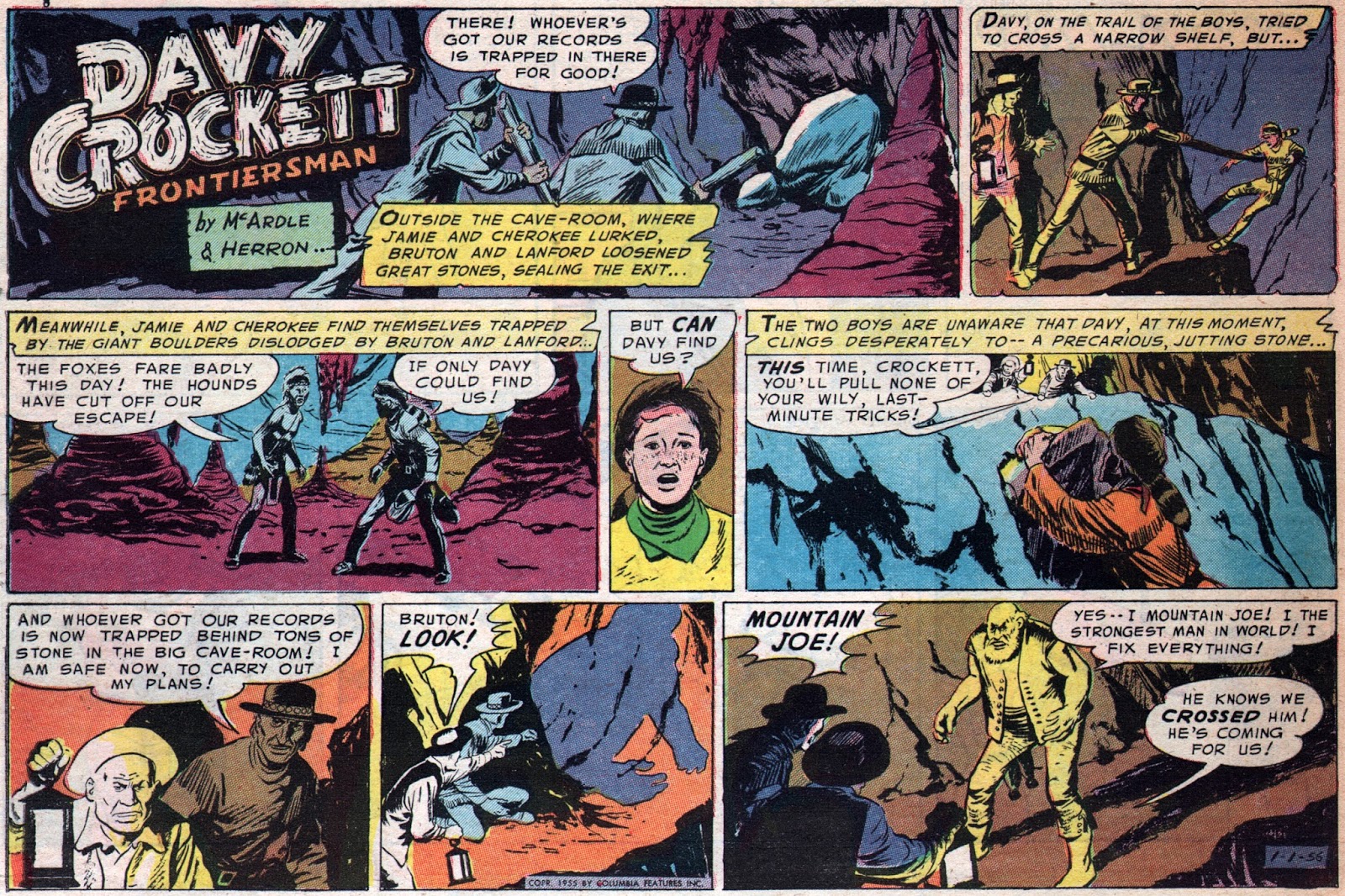
January 8, 1956

January 15, 1956

January 22, 1956


February 12, 1956

February 19, 1956

February 26, 1956

March 4, 1956

April 1, 1956

April 15, 1956

May 13, 1956

May 27, 1956

June 3, 1956

June 10, 1956

June 17, 1956

June 24, 1956

July 15, 1956

July 22, 1956

September 16, 1956

September 23, 1956

September 30, 1956

October 7, 1956

October 14, 1956

November 18, 1956

November 25, 1956

December 2, 1956

December 9, 1956

January 20, 1957

January 27, 1957

February 3, 1957

February 10, 1957

February 17, 1957

February 24, 1957 - Art by Jack Kirby (pencils/inks) !!!!!

March 10, 1957

March 17, 1957


April 7, 1957

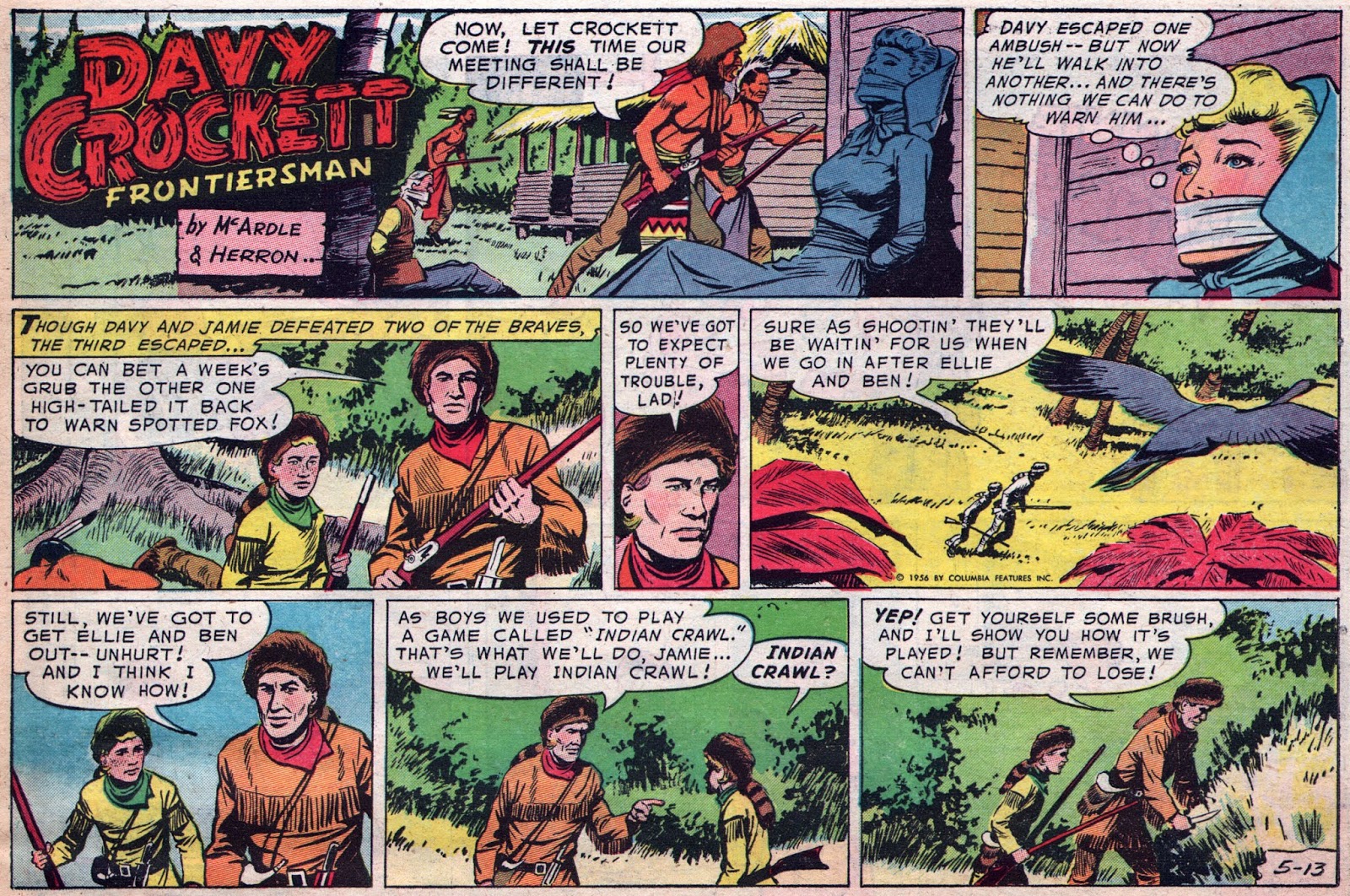
May 27, 1956

June 3, 1956

June 10, 1956

June 17, 1956

June 24, 1956

July 15, 1956

July 22, 1956

September 16, 1956

September 23, 1956

September 30, 1956

October 7, 1956

October 14, 1956

November 18, 1956
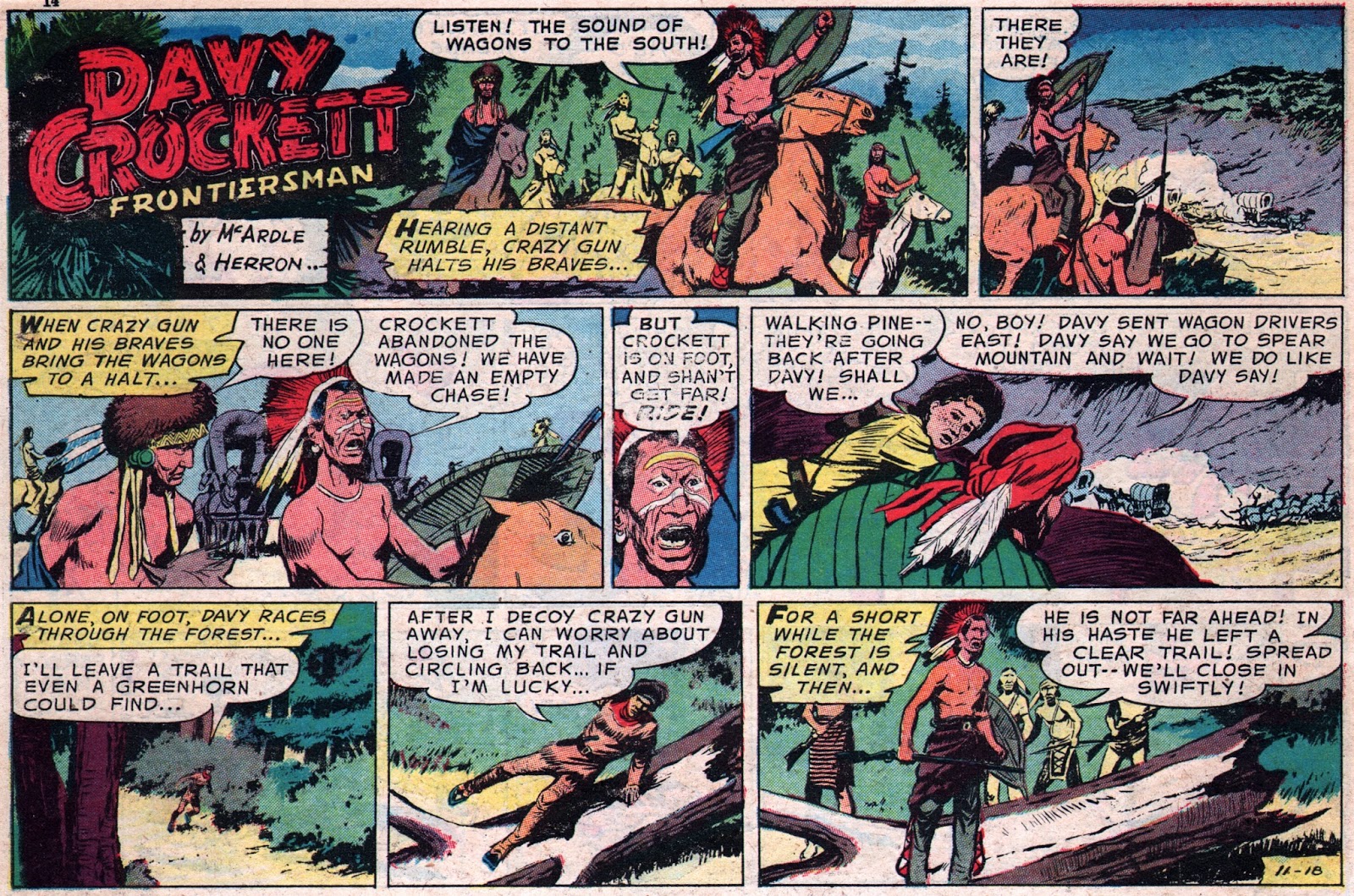
November 25, 1956

December 2, 1956

December 9, 1956

January 20, 1957

January 27, 1957

February 3, 1957

February 10, 1957

February 17, 1957

February 24, 1957 - Art by Jack Kirby (pencils/inks) !!!!!

March 3, 1957 - Art by Jack Kirby (pencils/inks) !!!!!
March 10, 1957

March 17, 1957

March 24, 1957

March 31, 1957

April 7, 1957

April 14, 1957

April 21, 1957

May 5, 1957

May 19, 1957

June 2, 1957

June 9, 1957

June 16, 1957

June 30, 1957

July 7, 1957

July 28, 1957

August 18, 1957

August 25, 1957


April 21, 1957

May 5, 1957

May 19, 1957

June 2, 1957

June 9, 1957

June 16, 1957

June 30, 1957

July 7, 1957

July 28, 1957

August 18, 1957

August 25, 1957